
What to expect from a Galápagos dive trip, including when to go, how to get ready for the currents, what animals you might see, and more!
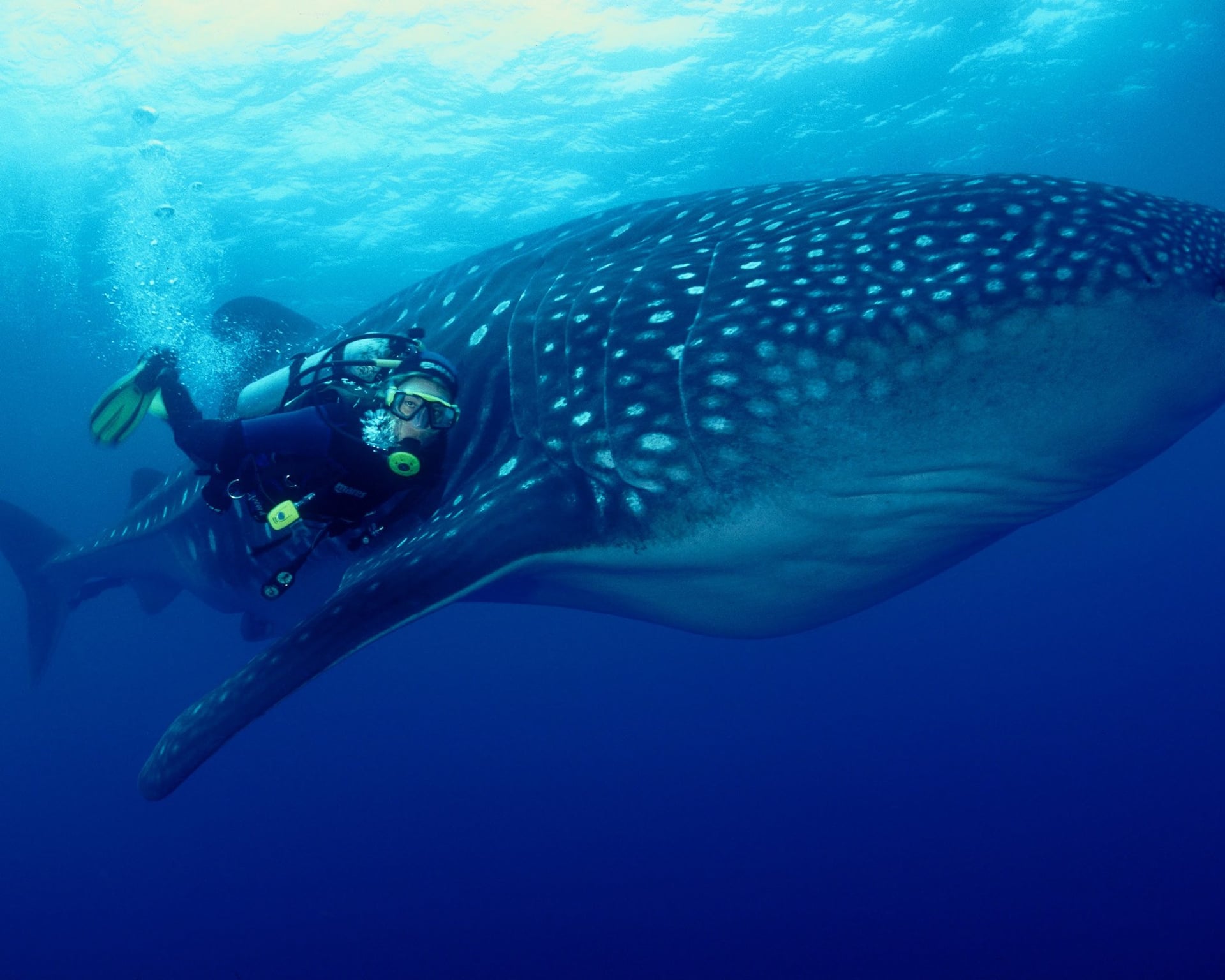
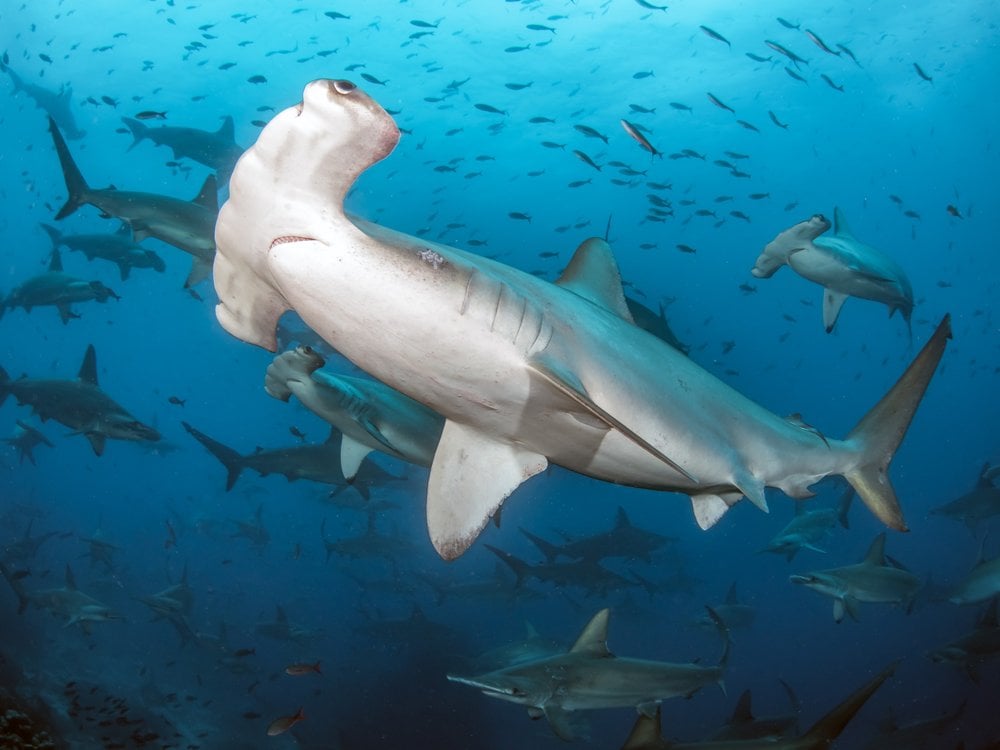
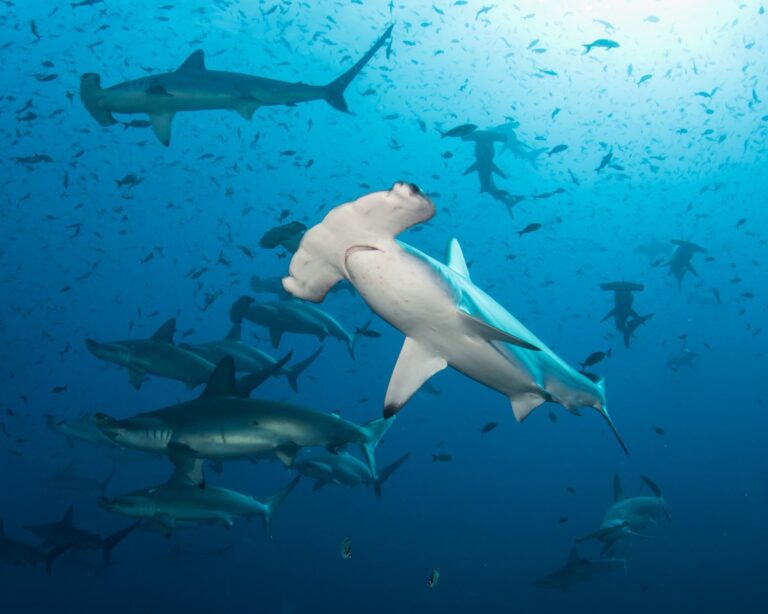
When asked to name the best diving in the world, divers consistently put the Galápagos Islands at the top of their list. Rather than vibrant coral reefs, this destination stands out for its sheer volume of marine life: schools featuring hundreds of hammerhead sharks around Wolf Island, massive whale sharks averaging about 11 m (36 ft) cruising past Darwin Island, alongside turtles, eagle rays, dolphins, and many other species.
However, diving in the Galapagos is not one single experience. Some sites can be reached on day trips from Santa Cruz or San Cristóbal, while the remote islands of Darwin and Wolf require a liveaboard and experience in strong currents and cold water. So the real questions are where to dive, which season fits the animals you want to see, and whether your experience matches the conditions.
PlanetaEXO, an ecotourism platform specializing in Galápagos Islands tours, has put together this guide to help you get ready for your diving trip. Check it out below!
Why is Galapagos diving among the best in the world?
The archipelago sits about 1,000 km (620 mi) off mainland Ecuador, where cold, nutrient-rich currents rise from the deep and meet warmer tropical water. That mix feeds plankton and schools of fish, which brings the sharks.
Fishing is tightly controlled—ocean waters surrounding the archipelago are safeguarded by the Galápagos Marine Reserve. In January 2022, Ecuador expanded protection by establishing the Hermandad Marine Reserve, incorporating approximately 60,000 km² (23,000 mi²) of additional marine habitat. This expansion brought the total protected area to nearly 200,000 km² (77,000 mi²).
Designed to safeguard a key shark migratory corridor between the Galápagos and Cocos Island in Costa Rica, fully half of this newly added marine zone is strictly closed to all commercial and recreational fishing activities.
The islands also hold site no. 1 on UNESCO’s World Heritage List, inscribed in 1978, while the marine reserve was added in 2001.
Diving here focuses on large animals rather than coral reefs. Divers spend most of their time holding still, watching the open sea to admire marine life pass—which beautifully changes depending on the location and season.


Galápagos dive sites at a glance
Galápagos dive spots are generally divided into two main categories: day-trip destinations accessible from settled islands and far-flung locations reachable exclusively via liveaboard.
Conditions change from day to day, so take this as a guide, not a promise:
| SITE | WHERE | HOW YOU GET THERE | CONDITIONS | WHAT YOU MAY SEE |
|---|---|---|---|---|
| Wolf Island | Far north | Liveaboard only | Strong current and surge. | Hammerhead schools, Galápagos sharks, green turtles, eagle rays. |
| Darwin Island (the Pillars) | Far north | Liveaboard only | Strong current, open water. | Hammerheads, whale sharks (July to December), dolphins, tuna. |
| Cape Douglas (Fernandina) | West | Liveaboard only | Shallow, strong surge, cold water. | Marine iguanas feeding underwater, sea lions. |
| Punta Vicente Roca (Isabela) | West | Liveaboard only | Deep wall, the coldest water of the trip. | Mola mola in the cool season, black coral, sea lions. |
| Cousins Rock | Central islands | Liveaboard (first days) | Wall, usually mild current. | Black coral, seahorses, frogfish, sea lions. |
| Gordon Rocks | Off Santa Cruz | Day trip from Santa Cruz | Strong current; operators ask for more experience. | Hammerheads, rays, turtles. |
| Kicker Rock | Off San Cristóbal | Day trip from San Cristóbal | Channel; the current changes from day to day. | Galápagos sharks, eagle rays, hammerheads at times. |
Darwin Island and Wolf Island: What to expect from diving tours?
Darwin and Wolf are two small volcanic islands at the far northern end of the archipelago—a 12-hour or longer overnight journey from the central islands. There are no day trips, and landings are not permitted, so visitors arrive only by liveaboard dive boat.
Wolf Island, Galápagos: the hammerhead wall
Wolf Island is where most divers see their first big school of hammerheads. The usual plan is a negative entry from a small boat (panga), a fast descent to a ledge of volcanic rock at 18 to 30 m (60 to 100 ft), then, following your guide, you hold on to bare rock and look into the blue.
In strong currents, divers stay low and still, as hammerheads are shy and turn away from bubbles and movement. At the end of the dive, it’s time to let go and drift—the safety stop often happens in open water with the sharks still around.
Wolf is also known for the number of green turtles, spotted eagle rays, and schools of barracuda and tuna. Some itineraries add an optional night dive here when conditions allow.

Darwin Island and the fall of Darwin’s Arch
For decades, the symbol of Darwin Island was a natural rock arch that rose from the sea less than a kilometer from the island. On May 17, 2021, the top of Darwin’s Arch collapsed—an event attributed to erosion by Ecuador’s Ministry of the Environment. Two columns remain, now known as the Pillars of Evolution. The site surrounding them continues to be one of the best diving spots in the archipelago.
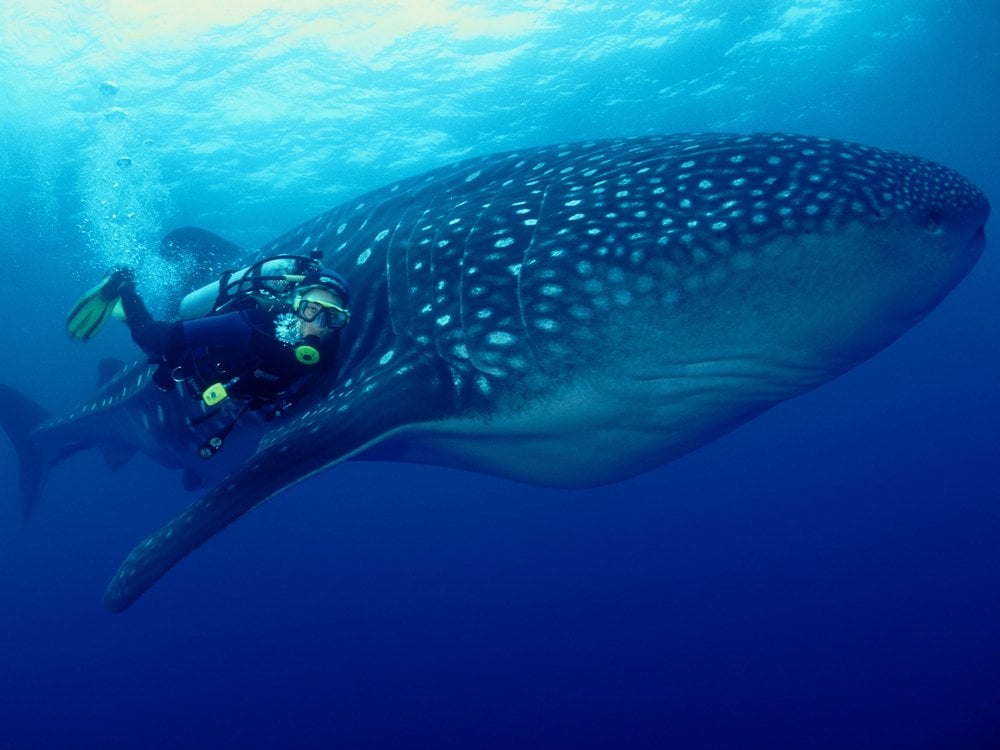
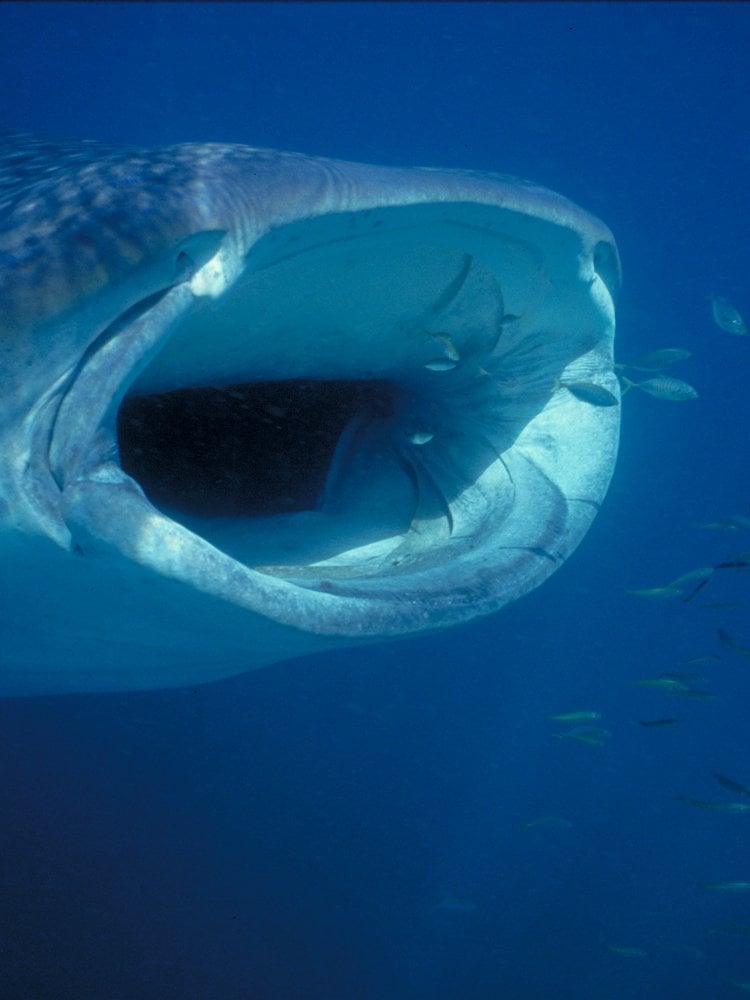
Darwin is the best place in the Galápagos to watch whale sharks. In a study published in 2014, researchers from the Galápagos Whale Shark Project recorded 207 out of 211 sightings between July and December. Most were large adult females, many with distended bellies—something the researchers interpreted as a possible sign of pregnancy.
Whale sharks remain at the island for only a few days before moving on. Consequently, even during the busiest months, sightings are not guaranteed.
Galápagos hammerhead sharks, whale sharks, and the rest of the cast
Galápagos shark diving is what attracts most people, but each part of the itinerary brings different animals:
- Scalloped hammerhead sharks: in schools at Wolf and Darwin all year, sometimes hundreds at a time.
- Whale sharks: at Darwin, mainly from July to December.
- Galápagos and silky sharks, dolphins, tuna, and eagle rays: around the northern islands.
- Manta rays: more often in the warm season, from December to May.
- Marine iguanas, sea lions, and Galápagos penguins: in the shallow, cold water of the west, around Fernandina and Isabela.
- Mola mola (ocean sunfish): at deeper sites in the west, such as Punta Vicente Roca, when the water is cold.
👉 Read more: 15 Galapagos Islands Animals: Facts & Where to See Them
Best time to dive in the Galápagos: warm season or cool season?
Diving in Galápagos is possible all year, with most liveaboard tours including Darwin and Wolf every week (weather permitting). What changes is the water and the cast.
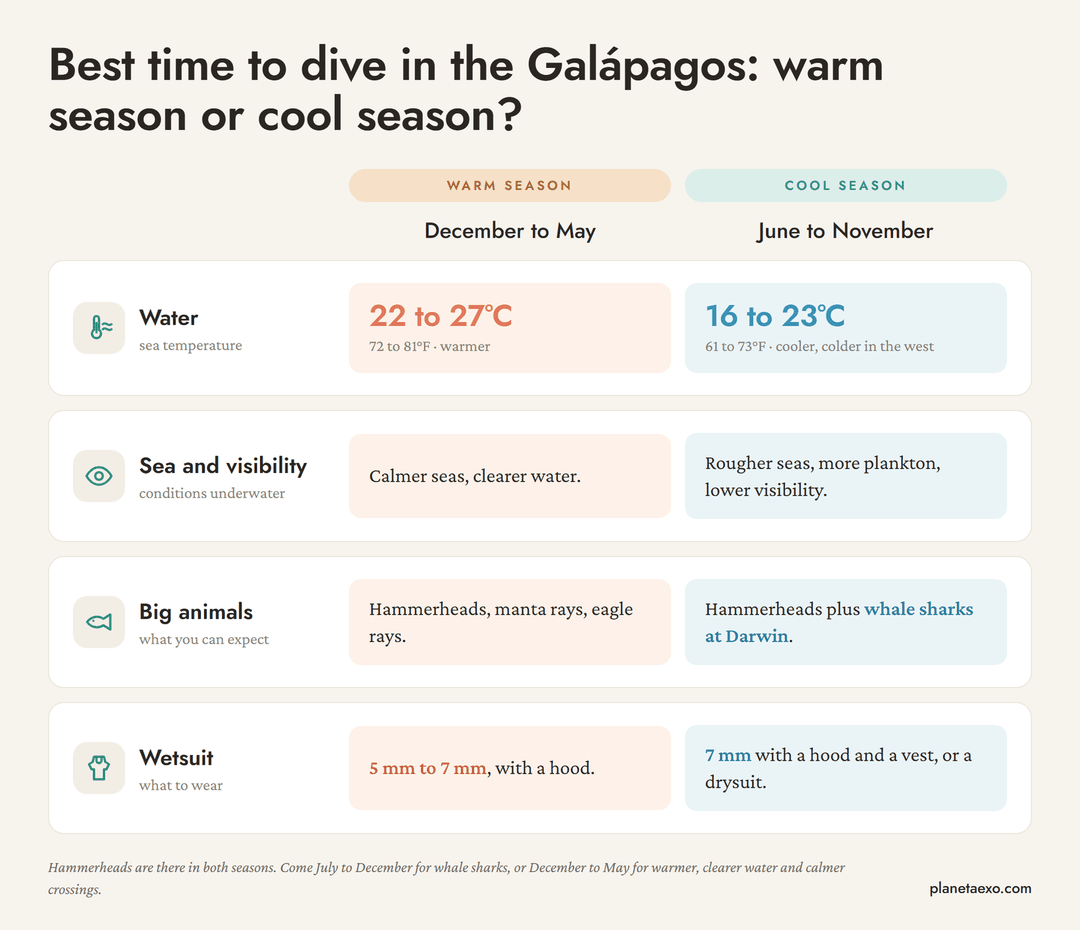
If seeing whale sharks is your goal, the best time to dive in the Galapagos is July to December, when almost all the sightings at Darwin happen. If you prefer warmer, clearer water and calmer crossings, choose the warm season, from December to May (December, the transition month, can still bring whale sharks). Hammerheads are there in both seasons, but there are indications that they appear more frequently during the cold season.
In any month, the western sites around Fernandina and Isabela are the coldest of the trip, with temperatures recorded between 14 and 17°C (57 to 63°F) during the cool season.
👉 Read more: Best Time to Visit Galápagos: Weather by Month
How a Galápagos liveaboard works, day by day
PlanetaEXO’s Galápagos liveaboard dive cruise offers a fully equipped vessel where passengers can eat, sleep, and dive for a week. The boat accommodates 16 guests in 8 cabins, divided into two groups of 8 divers, each with its own dedicated guide.
This is our 8-day tour (the sites and their order can change with the weather and the sea):
- Day 1 (San Cristóbal): boarding, safety briefing, and a short check-out dive to adjust your weights.
- Day 2 (North Seymour and Cousins Rock): a walk among blue-footed boobies and frigatebirds, two easy wall dives, then the overnight crossing north.
- Days 3 to 5 (Wolf and Darwin): up to four dives a day, including a night dive at Wolf.
- Day 6 (Fernandina and Isabela): the marine iguana dive at Cape Douglas and the cold, deep wall of Punta Vicente Roca.
- Day 7 (Pinzón and Santa Cruz): a last dive in the morning, then the giant tortoises of the Santa Cruz highlands while your body releases nitrogen before the flight.
- Day 8 (San Cristóbal): breakfast, a visit to the interpretation center while the crew takes your bags to the airport, then the flight back to the mainland.
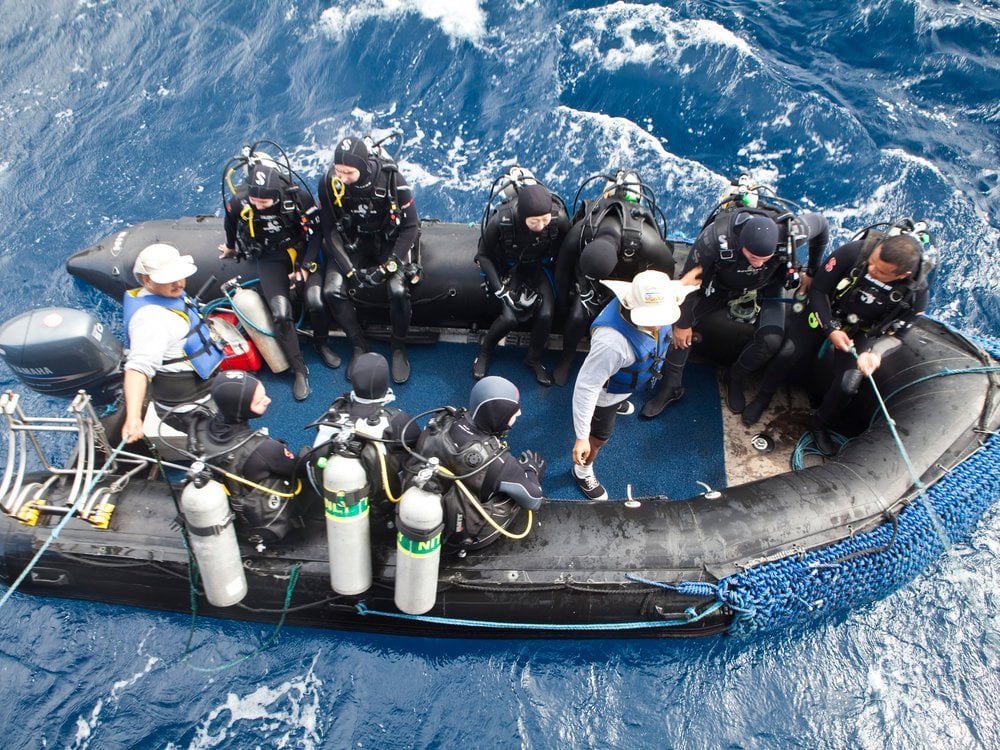
In total, you will complete approximately 18 dives lasting around 50 minutes each, staying strictly within no-decompression limits. Daily schedules begin early (6 AM), operating directly from pangas where divers suit up on deck and execute backward roll entries.
Complimentary Nitrox is provided for certified divers on our itinerary, which helps extend your bottom time within no-decompression limits on the repeated dives at Wolf and Darwin. As always, every dive relies on your dive computer and strict adherence to the guide’s briefing.


How much does a Galápagos dive trip cost?
The costs of diving in the Galápagos account for travel across the open ocean to reach the best sites, as well as the services and full infrastructure required for liveaboard accommodation.
Below is an overview of the 8-day itinerary from PlanetaEXO, along with additional costs:
| ITEM | COST | NOTE |
|---|---|---|
| Galápagos Liveaboard Diving: 8 Days at Wolf and Darwin | From US$7,495 (per person) | Shared cabin, all meals, 18 dives, Nitrox. |
| Galápagos National Park entry fee | US$200 (US$100 for Mercosur and Andean Community citizens) | Foreign adults over 12, paid on arrival in US dollars (bring cash); lower rates for children and residents. |
| Transit Control Card (TCT) | US$20 | Paid before the flight to the islands. |
| Hyperbaric chamber fee | US$35 | Charged by the boat; supports the chamber in Puerto Ayora. |
| Domestic flight, mainland to San Cristóbal | About US$525 to 575 (round trip) | Fare quoted for 2026. |
| Dive accident insurance | Required | Many travel policies exclude diving; check evacuation and chamber cover. |
| Gear rental and crew tips | Extra | Full rental about US$250 a week; tips about 10% of the cruise. |
Figures for November 2026, subject to change.
What experience do you need for scuba diving in the Galápagos?
Due to strong currents throughout the archipelago, dive operators maintain rigorous entry requirements. Although exact qualifications differ between boats, most liveaboards ask for the following baseline experience:
- Advanced Open Water (or an equivalent) as a minimum certification.
- At least 25 to 50 logged dives, depending on the boat. Our liveaboard recommends 50 to 100 or more, with at least one dive in the six months before the trip.
- A Nitrox certification if you want to dive on Nitrox, and night dive experience for the night dive.
- A minimum age (15 years old on ours).
Rather than the number of logged dives, your specific dive background is what truly counts. Divers who face challenges in the Galápagos typically have extensive backgrounds in warm, gentle reef environments but lack experience handling cold temperatures, heavy surges, or powerful currents. Before you go, make sure you can descend fast without a line, hold your depth in a current, and launch a surface marker buoy (SMB) from depth.
For those building up their skills, gain experience with current diving locally or explore our Fernando de Noronha diving guide in Brazil as a good first step!

Liveaboard or day trips from the islands?
You can also dive in the Galápagos from a hotel in Santa Cruz or San Cristóbal, with day trips of two dives. The best-known sites are Gordon Rocks (strong currents and hammerheads, where operators ask for more experience), Kicker Rock near San Cristóbal (sharks and rays in a channel where the current changes from day to day), and North Seymour.
Day trips are a good choice if you travel with non-divers, want land visits every day, or do not yet have the experience for Darwin and Wolf. However, this type of experience cannot reach the northern islands, so the hammerhead schools and the whale sharks of Darwin are out of range.
If those two islands are your main goal and you have the experience, choose liveaboard; if you want to mix diving with time on the islands, day trips fit better. Please note that neither option guarantees any animal.
There is also a middle path. Some naturalist cruises add optional dives with a licensed local dive operator, whose boat picks you up at the yacht. On our 8-day yacht cruise, you can add up to four dives (Cousins Rock, Bartolomé, and North Seymour for all levels, and Gordon Rocks for divers with 20 or more logged dives).
Not certified yet? Our 8-day Galápagos adventure tour offers a discovery dive with an instructor on Santa Cruz as an extra!
| DAY TRIPS FROM THE ISLANDS | LIVEABOARD | |
|---|---|---|
| Sites you reach | Gordon Rocks, Kicker Rock, North Seymour, and others near the towns. | Darwin, Wolf, and the western sites. |
| Dives | Usually 2 a day. | Up to 4 a day, about 18 in a week. |
| Experience | Certified divers; more experience for Gordon Rocks. | Advanced divers at ease in strong current. |
| Non-divers | Can join land tours on the same trip. | The boat is set up for divers. |
| Where you sleep | A hotel on Santa Cruz or San Cristóbal. | A cabin on the boat. |
| Cost | Paid per dive day. | One price for the week (ours from US$7,495). |
Price for November 2026, subject to change.
👉 Explore the adventure: 6-Day Galápagos Land Tour: Santa Cruz, Isabela & San Cristóbal
Gear and safety checklist for Galápagos diving
What to bring:
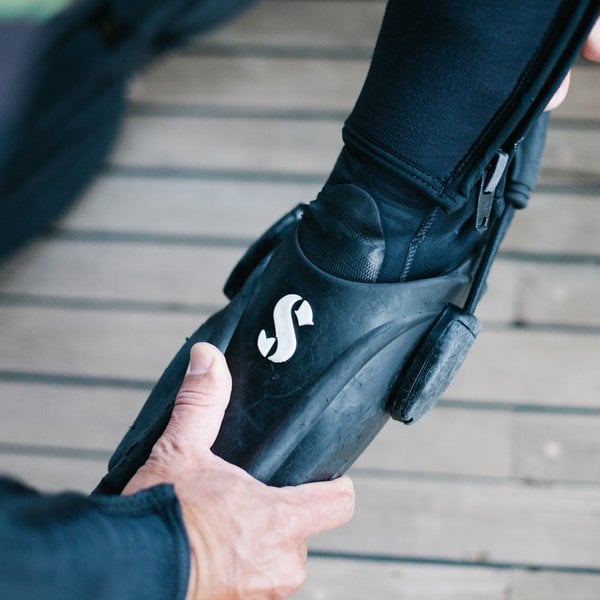
- A 7 mm wetsuit with a hood, plus a vest or a drysuit if you get cold easily. Hoods and vests are rarely available to rent, so bring your own.
- Your own dive computer, and ideally a backup. Rental computers are limited.
- Gloves and reef hooks only if your boat allows them. Rules differ between boats, so ask before you pack. Ours asks for thin gloves of 1 to 2 mm.
- An SMB, a whistle and a GPS locator. Check what your boat lends before booking.
- Dive accident insurance, required on most boats. Many travel policies exclude diving, so check that yours covers your planned depths, evacuation from a remote island, and hyperbaric treatment.
- Seasickness medicine for the long crossings in the open sea.
Safety habits:
- Time before your flight. Divers Alert Network (DAN) recommends waiting at least 18 hours after multiple dives before flying, and double that when landing above 8,000 ft (2,438 m). While Quito’s airport sits just below this at 2,400 m (7,900 ft), the city reaches 2,850 m (9,350 ft); staying an extra night in Guayaquil or on the islands is safer. Our itinerary schedules the final dive on the morning of Day 7, 18–24 hours before flying home.
- Dive responsibly. Do not chase or touch wildlife, stay 2 m (6 ft) away, hold only bare rock, and strictly follow your guide’s briefing.


Common mistakes on a Galápagos dive trip
- Chasing a whale shark into the blue: the current takes you away from the group and the rock, and it is hard to swim back.
- Watching the camera instead of the gauge: a school of hammerheads makes it easy to lose track of air, depth, and your buddy. Check your instruments often and stay with the group.
- Grabbing rocks without looking: divers report crushed fingers and kicks to the face when a group clings to the same ledge in strong current.
- Packing for the tropics: Galápagos is on the equator, but the water in the west is cold enough for a hood and a vest.
- Arriving on the day of departure: boats do not wait for late flights, so reach mainland Ecuador at least a day before and take the first flight to San Cristóbal.
Frequently asked questions
Is Galápagos diving good for beginners?
Darwin and Wolf require an Advanced certification and extensive logged dive experience due to challenging conditions. However, newly certified divers can join day trips from Santa Cruz or San Cristóbal to sites like North Seymour or Kicker Rock when the current is mild. Uncertified travelers can also take a discovery dive with an instructor on Santa Cruz.
Can you dive Darwin and Wolf on a day trip?
No. The islands are too far from the inhabited islands, and the crossing takes all night. Only liveaboards go there.
When is whale shark season in the Galápagos?
From July to December, mainly at Darwin Island. Most of the whale sharks seen there are large adult females, and no sighting is guaranteed.
What happened to Darwin’s Arch?
The top of the arch collapsed on May 17, 2021, from natural erosion. Two rock pillars remain, and the dive site next to them is still one of the best in the islands.
How many dives do you do on a Galápagos liveaboard?
PlanetaEXO’s 8-day itinerary plans 18 dives, with up to four a day at Wolf/Darwin and one or two on the first and last days.
Diving in Galápagos with PlanetaEXO
Now that you know what Galapagos diving is like, it’s time to plan your tour so you can see all this beauty for yourself!
PlanetaEXO is an ecotourism platform specializing in Ecuador adventure tours. We work with local dive operators and help you compare the options for your dates and your experience, from the season to the flights. Contact us now!
Keep reading
November 17, 2026
How to Get to the Galápagos Islands: Flights, Fees, and Entry Rules
Don’t know how to get to the Galápagos? Learn everything about airports, entry fees, transit cards, biosecurity rules, island hopping, and much more!
November 9, 2026
Best Time to Visit the Galápagos Islands, Month by Month
The best time to visit Galápagos, in Ecuador. See the air and sea temperature, rain, wildlife seasons, and crowds. See when you should book your trip!
November 6, 2026
15 Galapagos Islands Animals and Where to See Them
Discover the most fascinating facts about the animals in Galapagos, from giant tortoises to whale sharks, and where you can spot them during your trip!