
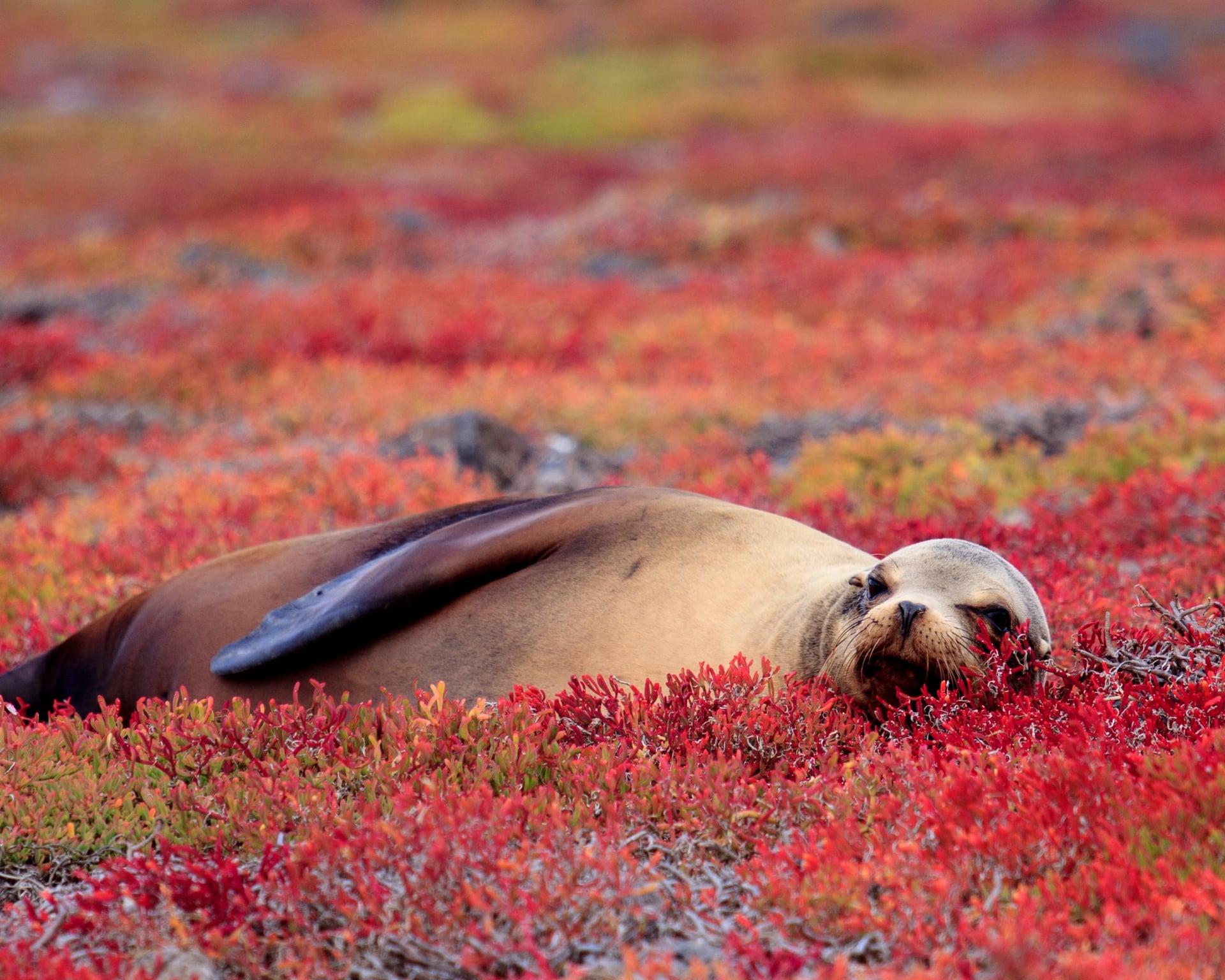
When to go to Galápagos? Check out the climate breakdown for each month, including information on water and air temperatures, rainfall levels, wildlife, and tourist activity!
Positioned right on the equator, the Galápagos Islands enjoy warm weather year-round. Historical weather measurements gathered by the Charles Darwin Research Station in Puerto Ayora on Santa Cruz (at 0.74° S) since 1965 reveal that September, the coldest month, still sees daytime coastal highs of 24°C (76°F) on average.
So the best time to visit Galápagos is not about warmth or cold. What really changes are the sea, the sun, and the wildlife. Water temperatures shift by roughly 4 °C (7 °F) between March and September, while daily sunshine hours more than triple. At the same time, unique wildlife breeding events, climate shifts, and tourist numbers fluctuate across the calendar.
Want to see what each month looks like before you choose the date for your trip? PlanetaEXO, an ecotourism platform specializing in Galápagos Islands tours, has put together this guide. Check it out below!

The short answer: the best time to visit Galápagos
Choosing the best month to visit Galápagos really comes down to your priorities, as both primary seasons present unique features:
- December to May (warm season): hot sun, the warmest sea (up to about 26°C/78°F in March), and the calmest water for snorkeling. It is also the rainy season at the coast, with short, heavy showers. This is also when green turtles nest.
- June to November (cool season): cooler air, cloudy skies, and the misty drizzle locals call garúa, a cooler sea (about 21.5°C/71°F in August–September), and a choppier ride between islands. In exchange, you might see whale sharks at Darwin Island, waved albatrosses on Española, and giant tortoises up in the highlands.
When it comes to the crowds, visitor numbers peak in March and April and then in July and August, while September is the quitest month. The Christmas and New Year weeks are high season, which means tour prices can increase significantly.
If you want warm water and sun, the best time to go to Galápagos is February to April. If you want big marine life and fewer people, go in the cool season, ideally in September.

Galápagos weather by month
This climate data below represents the 1991–2020 multi-decade averages recorded at the Charles Darwin Research Station in Puerto Ayora (coastal Santa Cruz), as published by the Charles Darwin Foundation.
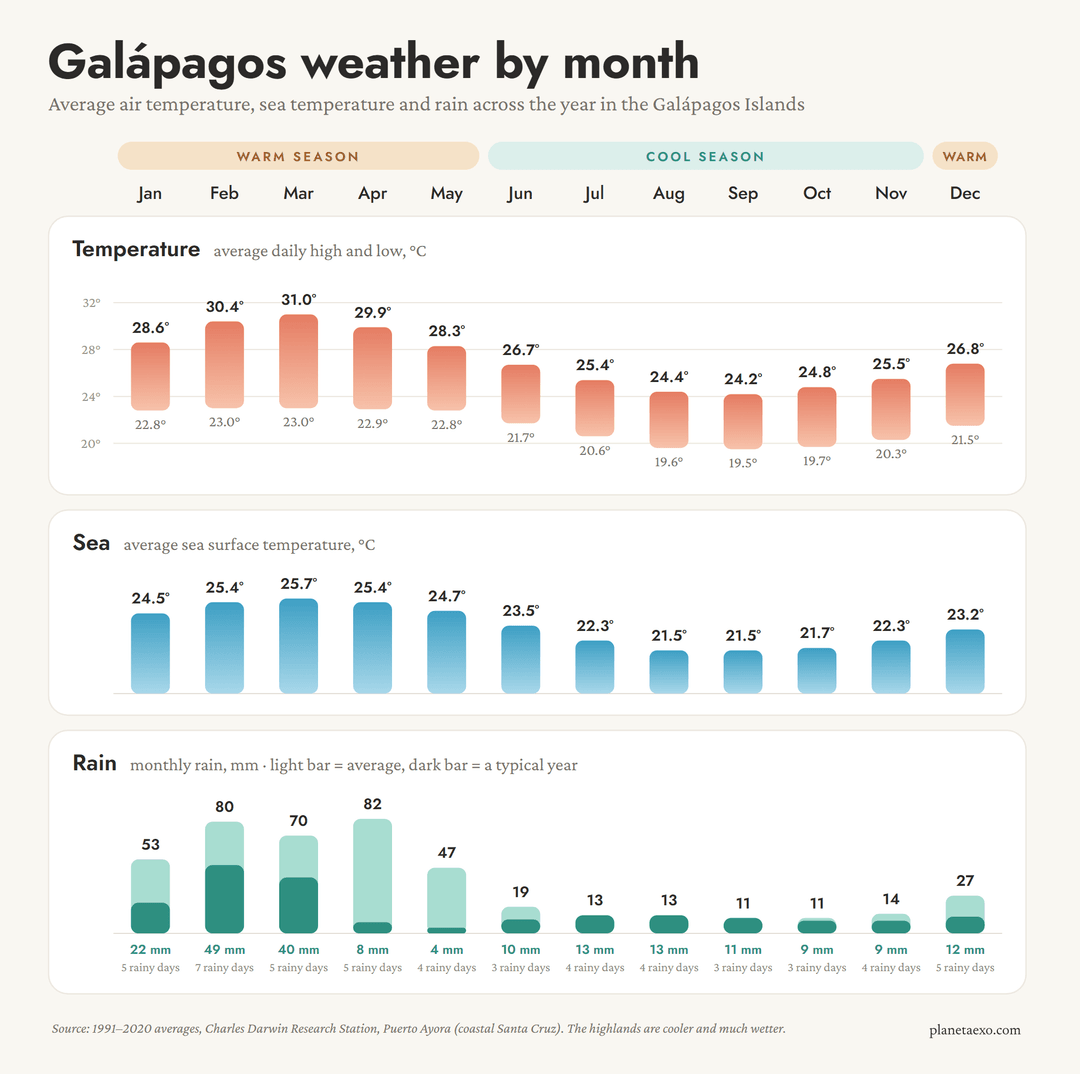
Rainfall varies drastically between years. Strong El Niño cycles bring heavy downpours—reaching 2,769 mm in 1983 and 1,751 mm in 1998, compared to a typical median year of ~271 mm. To accurately reflect these patterns, our infographic features both historical averages and median metrics for standard seasons. For example, while extreme spikes push April’s average to 82 mm, a typical April sees only 8 mm of rain.
Altitude also has a significant impact on the Galápagos climate. While coastal areas experience rain on just 3 to 4 days per month from July to September, the Santa Cruz highlands tell a different story. In Bellavista (223 meters above sea level), annual rainfall reaches approximately 1,100 mm, with misty conditions producing drizzle on 14 to 17 days monthly throughout the cool season.

Warm season: December to May, sun and warm water
December
Galápagos in December is a bridge month. The sea warms to about 23°C (74°F), highs reach 27°C (80°F), and the first warm-season showers arrive, with rain on about 5 days.
It is also holiday time: departures between December 20 and January 3 carry a high-season surcharge on land tours. The national park’s green turtle nesting program starts this month.


January
January brings highs of about 29°C (83°F), nights around 23°C (73°F), and a sea of 24.5°C (76°F). The sun shines about 5 hours a day, against 2 hours in the middle of the cool season. The rains return in brief downpours, leaving the vegetation on the islands more vibrant.
February
February is the wettest month in a typical year, with about 49 mm over 7 rainy days. In general, rain falls in short bursts, with highs of 30°C (87°F). The sea temperature is above 25°C (78°F), making it one of the warmest times of the year for snorkeling.
March
Galápagos in March is the peak of the warm season. It is the hottest month (highs of 31°C/88°F), the sea is the warmest of the year at 25.7°C (78°F), and the sun shines almost 8 hours a day
This is also one of the two busiest periods. Records from the national park show that the arrival of foreign visitors tends to peak in March and April.


April
April is still hot, with highs near 30°C (86°F) and the sea at 25.4°C. In a typical year, it is fairly dry (~8 mm), even if El Niño years push the average to 82 mm.
The waved albatrosses return to Española Island to begin nesting in April, remaining on the island through December.


May
May is the turn of the season. Highs drop to about 28°C (83°F), the median rain falls to about 4 mm, and the sea starts to cool, from 24.7°C (76°F) now to 21.5°C (70°F) by August. This is the last month of the green turtle nesting season.
Cool season: June to November, garúa and rich seas
June
June is the second bridge month, almost a mirror of December: highs of 27 °C (80 °F) and a sea of 23.5 °C (74 °F). The skies close up, and sunshine drops to about 3 hours a day.
On Santa Cruz, the large adult giant tortoises start their walk of up to 10 km into the highlands, where the mist keeps the plants green.

July
Galápagos in July means highs of about 25°C (78°F), nights near 21°C (69°F), and a sea of 22°C (72°F). The coast is dry, but the highlands are misty and damp. The southeast wind picks up, and the sea gets choppier, making boat crossings between islands rougher.
July and August are the busiest months for Ecuadorian visitors.
August
Almost as cool as September, August shows highs of 24.4°C (76°F) and lows of 19.6°C (67°F). The sea is down to 21.5°C (71°F)—a wetsuit makes snorkeling much more comfortable. In the highlands, it drizzles on about 17 days of the month.


September
As the coolest month of the year, September experiences highs of 24.2°C (76°F) and lows of 19.5°C (67°F). Water temperatures drop to 21.5°C (matching August’s low), while daily sunshine reaches its annual minimum of 2 hours per day.
With the lowest number of visitors of the year and falling right in the middle of whale shark season at Darwin and Wolf, this is the best time to visit the Galápagos for those seeking tranquility and active marine life.
October
October is remarkably dry along the shoreline, recording an average of roughly 10.9 mm of rain. The weather stays cool, with daily highs hitting 24.8°C (77°F) and water temperatures averaging 21.7°C (71°F).

November
Galápagos in November warms slowly: highs of 25.5°C (78°F) and a sea of 22.3°C (72°F). Rain falls on only 3 or 4 days. If you want the cool-season wildlife without the July and August crowds, it is one of the best months to go.
Best time to go to Galapagos for wildlife: seasons and where you can see animals
You can see wildlife in Galápagos every month. A few events, though, follow a calendar:
- Green turtle nesting (December to May): the Galapagos National Park monitors the nests every year in these months, on beaches of Isabela and Santa Cruz.
- Waved albatross (April to December): arrives on Española around March and April and stays until December. Between January and March, there are hardly any on the island.
- Giant tortoises on the move (from June): on Santa Cruz, the adults walk up to 10 km into the highlands at the start of the cool season and spend it at about 400 m. They come back down to the lowlands when the rains start. Young tortoises stay low all year.
- Whale sharks (July to December): usually spotted by divers at Darwin and Wolf Islands.
👉 Read more: 15 Galapagos Islands Animals and Where to See Them


Galápagos water temperature, snorkeling, and diving
Water temperature plays a key role in determining the ideal season for snorkelers and scuba divers. Sea surface temperatures in Puerto Ayora vary throughout the year, ranging from a warm 25.7°C (78°F) in March to a cooler 21.5°C (71°F) during August and September. Conditions change depending on the region:
- Western Islands (Fernandina & Western Isabela): water temperatures are significantly cooler, averaging 19°C (66°F) and occasionally dipping to around 16°C (61°F) in September.
- Northern Islands (Wolf & Darwin): these remote northern areas maintain the warmest waters in the archipelago, ranging between 24°C and 26°C (75°F to 78°F).
- Central Archipelago (Puerto Ayora): temperatures range from 21.5°C (71°F) in late summer to 25.7°C (78°F) in early spring.
Wetsuits are included with snorkeling gear on all of PlanetaEXO’s land tours. For cruise travelers, 2 mm shorty and 3 mm full wetsuits are available to rent onboard; opting for a full wetsuit is highly recommended during the cool season.
For scuba enthusiasts, the best time to dive Galápagos is all year long, as liveaboards depart weekly for Wolf and Darwin. The warm season from December to May offers clearer sea visibility and calmer surface conditions.
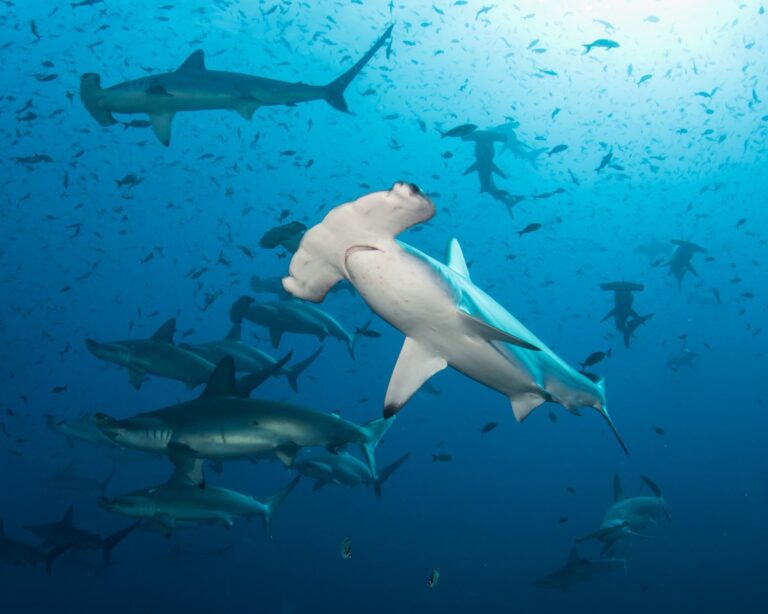
From June to November, cooler nutrient-dense waters bring stronger ocean currents alongside peak whale shark sightings. While scalloped hammerheads patrol the archipelago year-round, departures fill several months in advance.
Crowds and holidays: when the Galapagos Islands are busiest
When it comes to the crowds, visitor numbers peak in March and April and then in July and August, while September is the quietest month. National park data indicates that nearly 290,000 travelers visited recently, with 62% coming from abroad and seven out of ten arriving via Baltra.


Busy months mean fewer free dates on boats and in hotels. For the Christmas and New Year weeks, and for the dive weeks in whale shark season, make sure to book several months ahead.
Which PlanetaEXO trip fits which month?
PlanetaEXO Galápagos tours operate year-round, meaning the timing of your visit shapes what you will experience rather than whether you can travel:
| TRIP | BEST MONTHS | DAYS | ROUTE AND HIGHLIGHTS |
|---|---|---|---|
| 6-day Galápagos land tour | Year-round | Sunday to Friday | Land-based, in Santa Cruz, Isabela, and San Cristóbal. |
| 8-day Galápagos adventure tour | Year-round | Saturday to Saturday | Land-based on the same three islands, plus a day trip to North Seymour. |
| 5-day Galápagos cruise | Year-round | Monday to Friday | Short cruise to Santa Fe, Bartolomé and Rábida, starting with the wild tortoises of the Santa Cruz highlands. |
| 8-day Galápagos expedition cruise | April to December (albatross season) | Friday to Friday | Eastern route, including Española, the albatross island. |
| Liveaboard dive week | July to December (whale sharks) | Sunday to Sunday | Departs from San Cristóbal, up to 16 divers. |
Ready to visit the Galápagos? Plan your trip with PlanetaEXO!
Now that you know what each month delivers, it’s time to choose yours: warm water and sun from December to May, or whale sharks, albatrosses, and quieter islands from June to November.


PlanetaEXO is an ecotourism platform specializing in Ecuador tours. We work with local operators and take care of the whole travel planning in the month that suits you. Whatever you decide is the best time to visit Galápagos for you, our team is here to help. Contact us now!
Keep reading
November 6, 2026
15 Galapagos Islands Animals and Where to See Them
Discover the most fascinating facts about the animals in Galapagos, from giant tortoises to whale sharks, and where you can spot them during your trip!
November 8, 2026
8 Best Torres del Paine Hikes, from Short Viewpoints to the W and O Treks
Discover the best Torres del Paine hikes in Chilean Patagonia. See real distances, times, cut-off hours, and the booking rules for the W and the O circuits!
November 7, 2026
How to Hike the Salkantay Trail to Machu Picchu in Peru – Travel Guide
Plan your Salkantay Trail hike to Machu Picchu in Peru, with the route, Humantay Lake, high pass, best season, days, where to sleep, and Salkantay vs Inca Trail!