
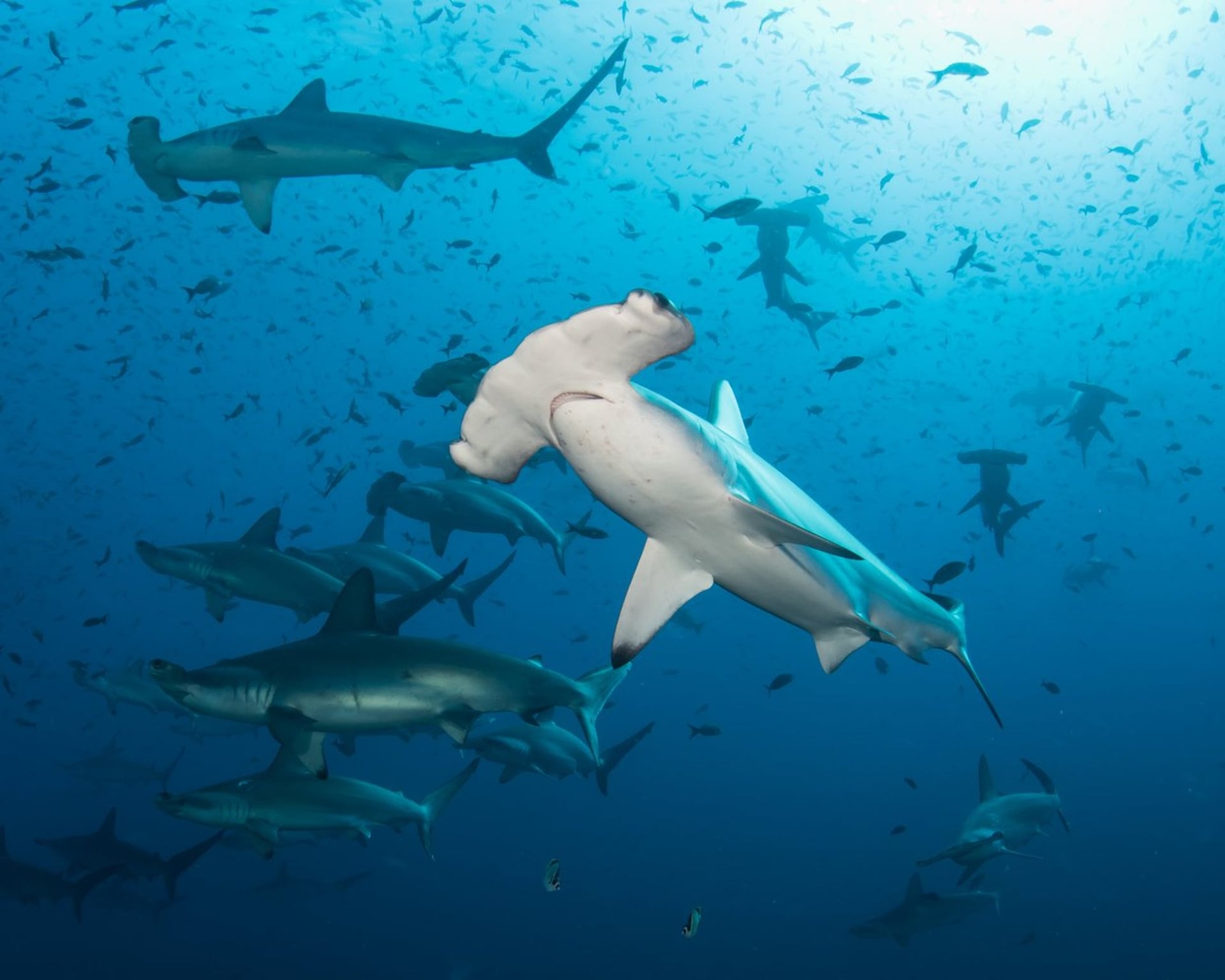
From the giant tortoises of the Santa Cruz highlands to the whale sharks of Darwin Island, here are 15 Galapagos Islands animals, with the facts worth knowing about each one and the places where you can find them!
Located 928 km (577 miles) off the coast of mainland Ecuador, the Galapagos Islands have been protected by a national park since 1959. This remote isolation directly influenced the unique evolution of local wildlife. As a result, roughly 97% of the land mammals and reptiles, alongside around 80% of the land bird species, are found nowhere else on Earth.
Many animals—especially the land birds—show little concern when visitors pass nearby. British naturalist Charles Darwin famously noted that the islands’ native doves would perch directly on his arms and head.
If you are wondering what animals live in the Galapagos Islands, which species you are likely to spot, and the exact locations to find them, you’ve come to the right place. PlanetaEXO, an ecotourism platform specializing in Galapagos tours, has put together a guide to this fascinating wildlife. Check it out below!

1. Galapagos Giant Tortoise
The islands are named after this one. Early Spanish explorers used the old word “galápago” (meaning “saddle”) for the shape of its shell. Scientists recognize about 15 species of Galapagos giant tortoise, one per island or per volcano on Isabela.
In two centuries, pirates, whalers, and fur sealers took 100,000 to 200,000 of them, because a tortoise could stay alive in a ship’s hold for up to a year without food or water. Today, about 20,000 to 25,000 live in the wild.

Fun facts about the Galapagos tortoise:
- They spread seeds through their droppings, carve out trails, and keep vegetation in check. On islands with tortoises, Opuntia cacti evolved into tall, tree-like forms, keeping their fruit and pads out of the tortoises’ reach.
- On Santa Cruz, many tortoises make a seasonal migration. They climb to the highlands in the dry season in search of green vegetation and head back down to the lowlands when the rains arrive.
- In the 1960s, only 14 tortoises were left on Española. Diego, a male who had been living at the San Diego Zoo in the US, was brought to the Galápagos to join them in a breeding program that produced more than 2,000 offspring, a large share of them his. In 2020, he returned to Española at more than 100 years old.
Where to find them: Wild in the Santa Cruz highlands, where they graze and soak in mud pools at reserves next to the national park, and at the breeding centers in Puerto Ayora (next to the Charles Darwin Research Station) and Puerto Villamil on Isabela, which raise young tortoises to restock the islands.

👉 Explore the adventure: 5-day Galápagos Islands Safari & Luxury Camp on Santa Cruz
2. Marine Iguana
The marine iguana is the only sea-going lizard in the world. It lives on land and feeds in the sea, grazing on seaweed on the rocks or diving for it in cold water. It lives on the coasts of all the main islands, in an area of only about 275 km².
Fun facts about marine iguanas:
- They swallow a lot of salt water along with the algae. Glands in their nose filter out the excess salt, and they expel it with a sneeze. That’s why many have a white crust of salt on their heads.
- In El Niño years, when the algae disappear, they shrink by up to about 20% of their body length, as the body reabsorbs part of its bones. When food returns, they grow back. The smaller the iguana, the less energy it uses and the better its chances of survival.
- Española’s iguanas turn red and turquoise-green in the breeding season and are nicknamed “Christmas iguanas.”
Where to find them: On the rocks of the Isabela wetlands, on the shore of North Seymour, in the mangroves of Playa Mansa, at Punta Suárez on Española, and underwater at Cape Douglas, in Fernandina.


3. Galapagos Land Iguana
Growing to more than 90 cm (3 feet) long and tipping the scales at up to 14 kg (30 pounds) for large males, the Galapagos land iguana includes 3 species: the yellowish found on six islands, the Santa Fe species restricted to its namesake island, and the Critically Endangered pink land iguana, which lives only on the slopes of Wolf Volcano on Isabela.
Fun facts about land iguanas:
- Their diet is based on the pads, flowers, and fruit of the Opuntia cactus. Sometimes they remove the spines with their claws by rolling the pad on the ground, but they also often swallow the spines without any trouble.
- On Fernandina, the females make an impressive journey. They climb several kilometers to the top of the volcano and descend to the floor of the crater to lay their eggs in the warm volcanic ash, which works as an incubator.
- In 1975, feral dogs wiped out two colonies in less than six months. The young were raised in a breeding center and returned once the dogs were gone. The last release at Cerro Dragón was in 1991.
Where to find them: Cerro Dragón on Santa Cruz, Santa Fe, North Seymour, and along the road from Baltra airport.

4. Galapagos Sea Lion
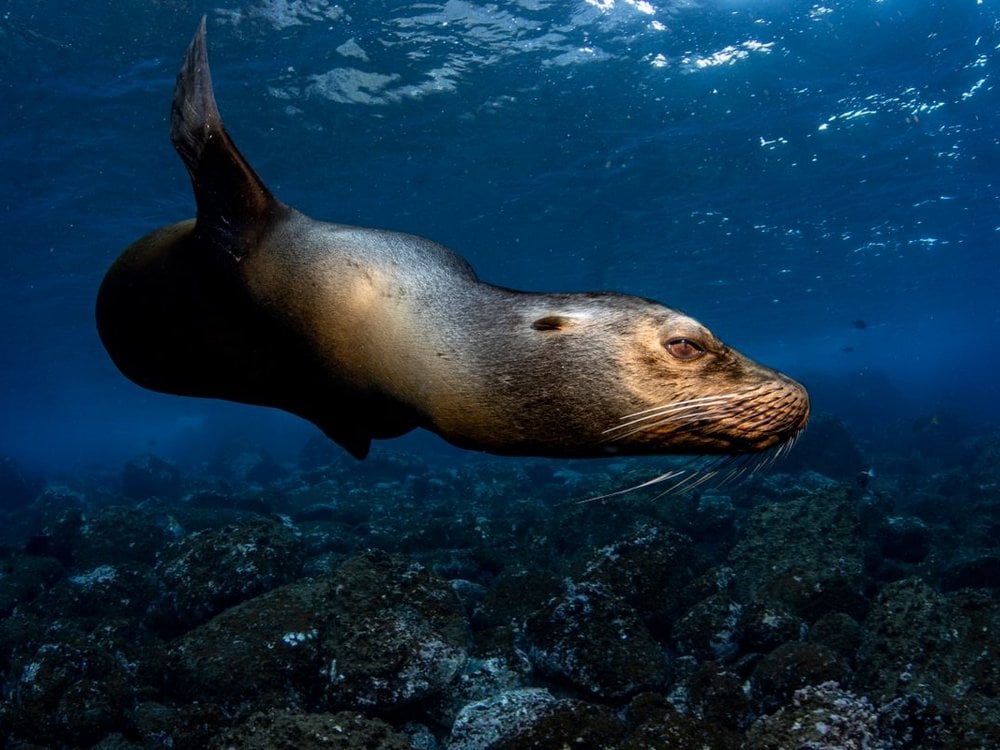
The sea lion is usually one of the first Galapagos Islands animals people see upon arrival. These friendly neighbors peacefully sleep on docks, benches, or beaches. Full-grown males weigh up to 250 kg (550 pounds), which makes them the largest species around.
Fun facts about the Galapagos sea lion:
- A female usually has one pup a year or every two years. They have delayed implantation—the embryo stays “on pause” for a few months before it starts to develop, which times the birth to the most favorable season.
- Males without a territory gather on “bachelor beaches,” away from the breeding colonies, while they build up the size and strength to fight for a stretch of their own.
- Because they evolved without land predators, they show almost no fear of humans. Young sea lions often play with snorkelers, swimming circles around them, blowing bubbles and nibbling at their fins.
Where to find them: La Lobería on San Cristóbal, Bahía Gardner on Española (one of the largest colonies in the archipelago), and the snorkel at Los Túneles on Isabela.
👉 Explore the adventure: 6-Day Galápagos Land Tour: Santa Cruz, Isabela & San Cristóbal

5. Galapagos Fur Seal
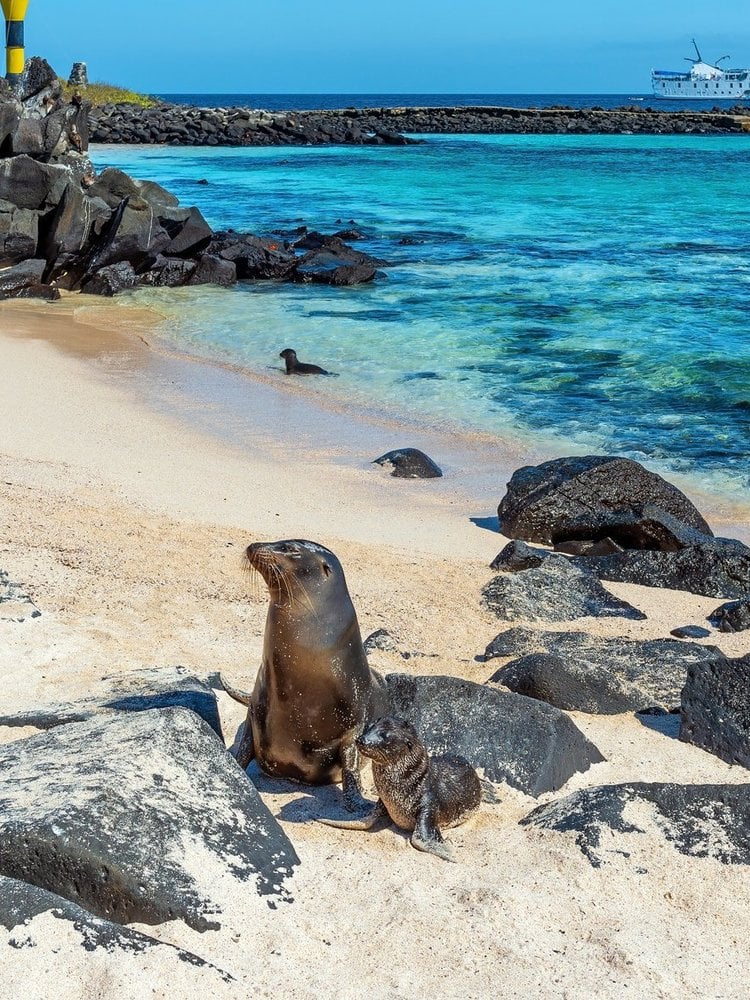
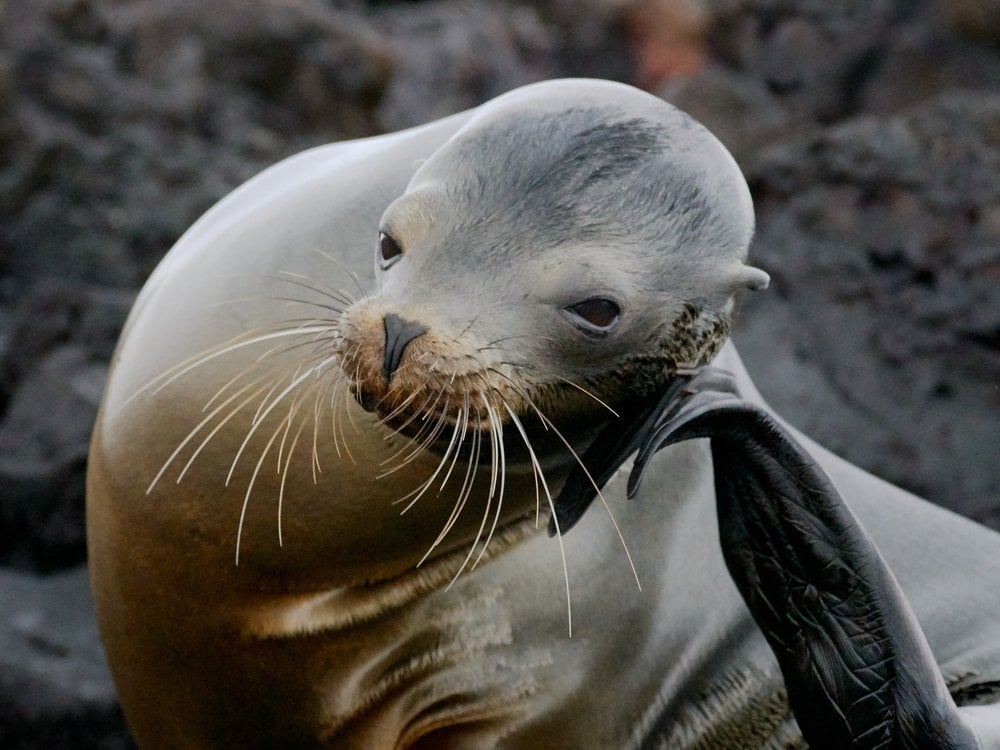
Despite its name, the Galapagos fur seal is actually a species of sea lion. It features a smaller frame, broader head, bulging eyes, and far thicker fur, which made hunters in the 1800s target them by the tens of thousands. Though their numbers have rebounded, the IUCN still lists the species as Endangered.
Fun facts about the fur seal:
- They hunt for squid and fish at night, limiting foraging when full moons make them vulnerable to predators like sharks.
- To escape the heat, they prefer rocky shores, shady spots, crevices, and caves.
- Pups nurse for 2 to 3 years. When a new pup is born while its older sibling is still nursing, the competition is fierce. The older one usually wins out, and the newborn often doesn't survive.
Where to find them: The El Barranco cliffs and Darwin Bay on Genovesa.
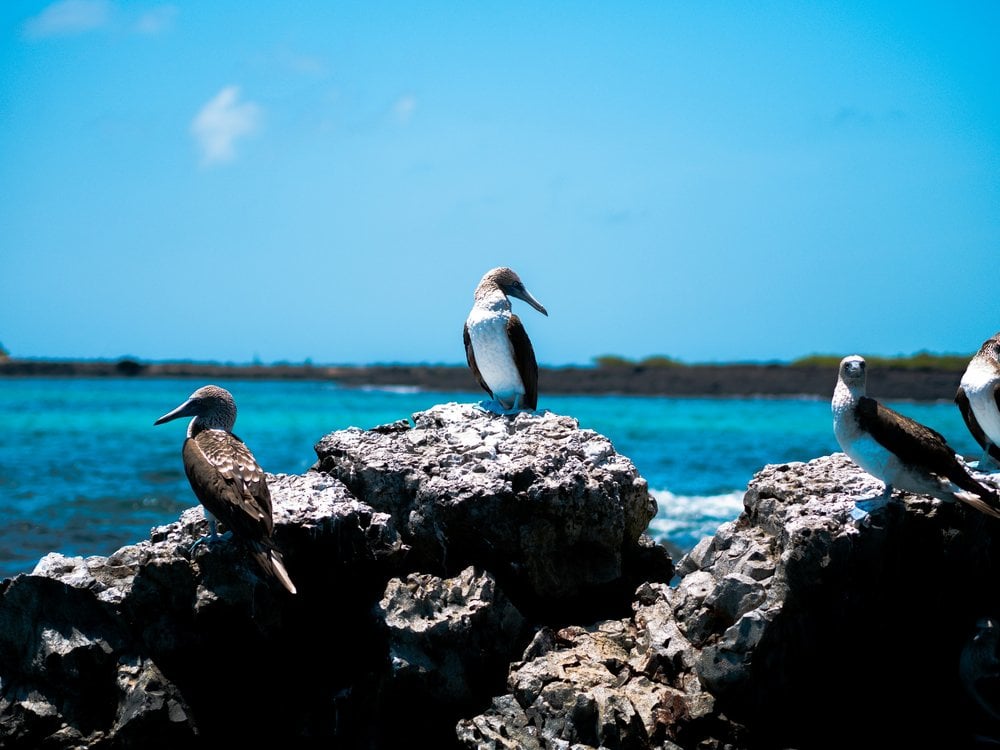
6. Blue-footed Booby
The blue-footed booby is the bird most people picture when they think of Galapagos wildlife. Males lift their bright feet one at a time in a slow courtship dance, often right beside the trail. They measure between 70 and 90 cm and catch fish by plunge-diving into the sea.

Fun facts about blue-footed boobies:
- The blue of their feet comes from carotenoid pigments they get from a diet of fresh fish. The brighter the color, the better fed and healthier the bird. If it goes hungry, the color fades within a few days.
- When they plunge into the water at high speed to feed, air sacs in their skulls cushion the impact. Their nostrils are sealed shut, so they breathe through the corners of their bills.
- The islands have 3 booby species: blue-footed, Nazca, and red-footed. The red-footed is the most numerous, but it nests in trees on the outer islands, which makes them harder to see.
Where to find them: North Seymour, the lava ledges above Los Túneles, and the rocks of Puerto Villamil Bay. Red-footed boobies are found in Genovesa.
👉 Explore the adventure: 8-Day Galápagos Adventure Tour: Island Hopping & North Seymour
7. Frigatebirds
Galapagos has 2 of the world’s 5 frigatebird species, the magnificent frigatebird and the great frigatebird. In the breeding season, males inflate a bright red throat pouch like a balloon and call to the females flying overhead.
Fun facts about frigatebirds:
- Because their feathers aren’t waterproof, they catch fish without letting their bodies touch the water. A waterlogged frigatebird can drown.
- They may also chase boobies or other seabirds through the air, sometimes tugging at their tails, until they drop or regurgitate their fish. The frigatebird then catches it before it hits the water. That's how they earned the nickname “pirates.”
- Chicks depend on their parents for more than a year, one of the longest periods of any bird. That's why a female lays a single egg only once every two years.
Where to find them: North Seymour, where males display beside the path, and Genovesa for great frigatebirds.

8. Galapagos Penguin
Recognized as one of the most famous Galapagos Islands animals, it is the only penguin living at or north of the equator. Standing among the smallest of its kind globally, the total population numbers around 2,000 birds. Cool marine currents carry cold, nutrient-dense water directly to Fernandina and Isabela, where roughly 95% of them reside.
Fun facts about the Galapagos penguin:
- During the day, it spends much of its time in the water, which is cooler than the air. On land, it pants like a dog and holds its flippers out to shed heat.
- It has no fixed breeding season, laying eggs whenever food is plentiful, which can happen up to two or three times in a single year. Pairs usually stay together for life.
- The El Niño of 1982–83 cut the population by 77%, and the one in 1997–98 by 65%. The species has never fully recovered. Today, it is listed as Endangered by the IUCN.
Where to find them: By kayak in the bay of Puerto Villamil on Isabela, now and then at Los Túneles, on the snorkels at Sombrero Chino and Bartolomé, and from a dinghy along Punta Vicente Roca.

👉 Explore the adventure: Galápagos Family Tour: 8-Day Adventure on Santa Cruz & Isabela
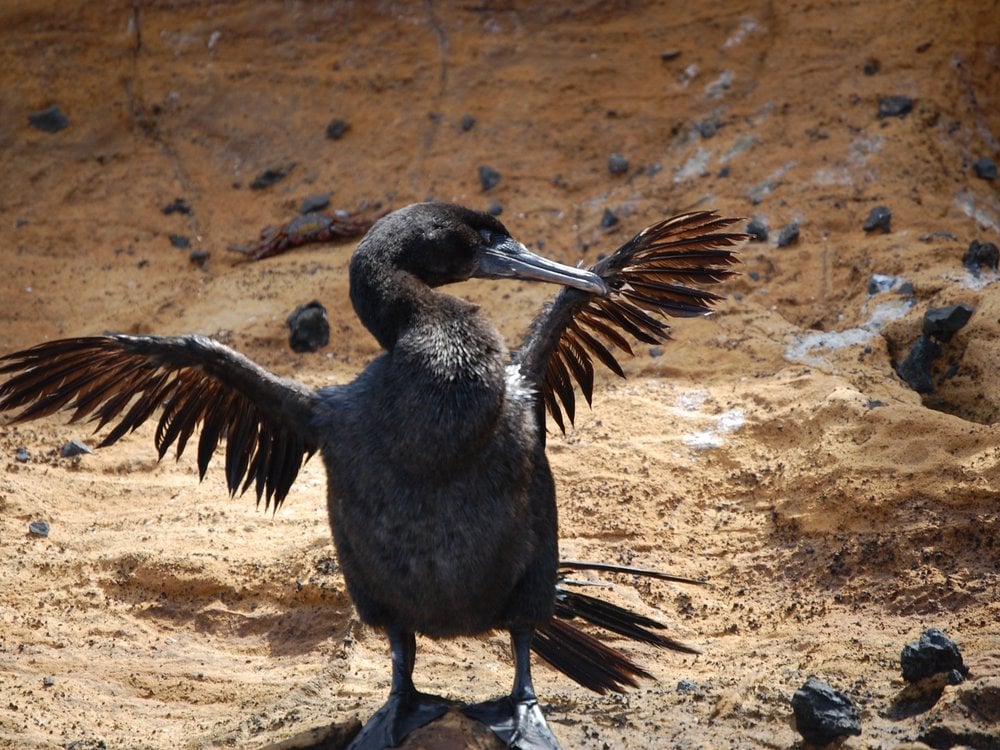
9. Flightless Cormorant
The flightless cormorant is the only cormorant in the world that can’t fly. Evolving without any land-based predators, it gradually lost the ability to take flight, relying instead on powerful legs and tiny, vestigial wings to propel itself through the sea. Today, an estimated 1,600 adults live solely along Fernandina and the northern and western shores of Isabela.
Fun facts about the flightless cormorant:
- Its eyes are an intense turquoise blue that stands out against its dark plumage.
- To win over a female, the male brings her gifts of seaweed, twigs, and even objects found in the sea, such as bottle caps and bits of rope.
- When food is plentiful, the female may leave the chick with the male and go off to find a new partner and start another nest. This kind of arrangement is rare among birds.
Where to find them: Only in the far west. A dinghy ride along Punta Vicente Roca, on Isabela’s west coast, passes them on the rocks.
10. Waved Albatross
The waved albatross breeds almost only on Española Island—at least 34,694 adults were counted on Española in 2001. Pairs mate for life and renew the bond every year with a long courtship dance. The species is listed as Critically Endangered, mainly because so many are caught by fishing lines.
Fun facts about the waved albatross:
- It’s the only albatross that breeds entirely in the tropics. Almost all other species live in the cold seas of the south or the North Pacific.
- On land, it’s heavy and clumsy. To take off, it waddles to the edge of the cliffs at Punta Suárez and launches itself into the wind, which serves as a natural “runway.”
- They arrive on Española around March and April and stay until December. Between January and March, there are hardly any albatrosses on the island. Young birds spend several years at sea without touching land before returning to the colony to breed.
Where to find them: Punta Suárez on Española, in season, together with Española mockingbirds, marine iguanas, and lava lizards.

👉 Explore the adventure: 8-Day Galápagos Yacht Cruise: Luxury Island Trip
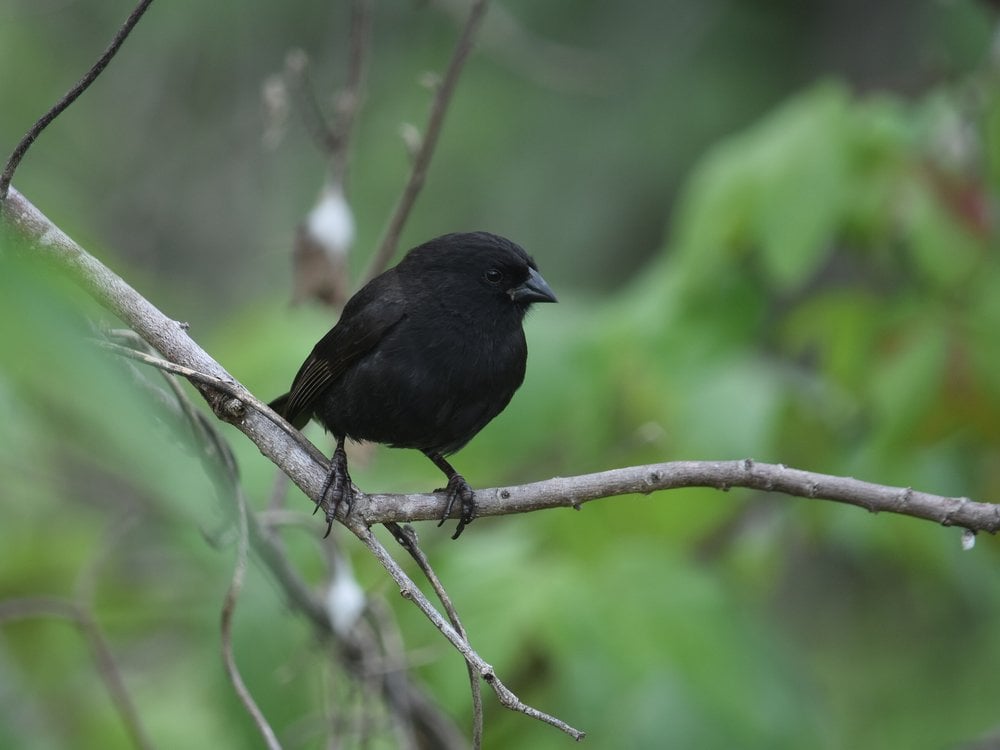
11. Darwin’s Finches
There are more than a dozen species of Darwin’s finches across the islands, each about the size of a sparrow. Among the most common Galapagos birds, their beaks evolved to feed on everything from seeds, leaves, and flowers to insects and blood. Together, they take on ecological niches handled by 7 different families on the continent.
Fun facts about Darwin’s finches:
- All the species descend from a single ancestor, a grassquit-like bird from the tanager family that reached the Galápagos from the mainland about 2 to 3 million years ago.
- Darwin collected specimens in 1835, but he didn’t even realize the birds were related, and he kept poor records of which island each one came from. It was the ornithologist John Gould, in London, who identified the group. In 1973, the British biologists Peter and Rosemary Grant began studying them.
- Males learn their song from their fathers, and females choose mates by the song of their own species. This helps keep the species apart.
Where to find them: Los Gemelos and Cerro Mesa in the Santa Cruz highlands, the Manzanillo tortoise reserve, and the coastal scrub of Bahía Borrero.
12. Galapagos Flamingo
The islands hold only about 320 to 350 birds. Elsewhere, flamingos need huge flocks to breed. Here, a few pairs are enough. The pink color of their feathers comes from the beta-carotene in the brine shrimp they filter from saltwater lagoons near the sea.
Fun facts about the Galapagos flamingo:
- The Galapagos flamingo is actually the American flamingo, the same species found in the Caribbean, northern South America, and Mexico. Studies suggest the Galapagos Islands population is isolated and has small genetic and size differences, with slightly smaller birds, but it isn’t recognized as a separate species.
- Chicks hatch pale gray and only turn pink over time as they build up the pigments. The “milk” produced in the upper digestive tract of both males and females is also reddish.
- They’re skittish and may abandon their nests if disturbed. At visitor sites, the rule is to keep your distance and stay quiet.
Where to find them: The lagoons of the Isabela wetlands near Puerto Villamil and sometimes the lagoon behind Garrapatero beach on Santa Cruz.

13. Green Sea Turtle
The most common Galapagos sea turtle is the East Pacific green turtle, which can be spotted on snorkeling tours. Females lay eggs on over 100 beaches across the archipelago, making it a critical nesting ground; Quinta Playa on southern Isabela receives 2,000 to 3,000 nests annually.
Fun facts about green turtles in the Galapagos Islands:
- Compared with green turtles in other oceans, it has a darker shell, almost black, and is usually smaller. Scientists still debate whether it's a subspecies, a distinct population, or just a variation.
- Hatchlings and juveniles are omnivores, eating small animals and plants. Adults are herbivores and feed mainly on algae and mangrove leaves.
- Nesting takes place mainly from December to June, peaking in the first months of the year. Mating is usually seen at sea between November and January.
Where to find them: Bahía Borrero on Santa Cruz, Los Túneles on Isabela, Kicker Rock off San Cristóbal, and the calm water of Playa Mansa in Tortuga Bay, best seen by kayak.

14. Scalloped Hammerhead
Schools of scalloped hammerheads are the reason many divers come to the islands. The Galapagos hammerhead schools gather near deep drop-offs in groups of up to 400 sharks. The IUCN lists the species as Critically Endangered after steep declines caused by overfishing.
Fun facts about scalloped hammerheads:
- The hammer-shaped head widens their field of vision, holds more ampullae of Lorenzini (pores that detect the electric fields of prey hidden in the sand), and helps with lift and maneuvering in the water.
- Females give birth to fully formed pups in litters that can exceed 20 to 30. The pups spend their first years in shallow, sheltered waters, away from the adults.
- At Darwin and Wolf, the sharks glide slowly through “cleaning stations,” where fish such as the barberfish and the king angelfish eat parasites off their skin. These are the spots where divers usually see them up close.
Where to find them: Wolf and Darwin, the two northern islands, reached only by dive liveaboards. Snorkelers at Kicker Rock sometimes spot one far below.

15. Whale Shark
Throughout the cooler months, Earth’s biggest fish cruises past Darwin Island. Research conducted by the Charles Darwin Research Station documented 82 whale sharks in these waters from 2011 to 2013. Remarkably, 91.5% were fully grown females measuring an average of 11.35 m (37 feet), with almost all showing signs of pregnancy. Today, the IUCN classifies the species as Endangered.
Fun facts about the whale shark in the Galapagos Islands:
- No one knows for sure where the females that pass through the Galápagos give birth. Researchers suspect the archipelago is a stopover on a migration route toward the open ocean.
- Each whale shark has a unique pattern of spots, like a fingerprint. Scientists use divers’ photos to identify and track each individual.
- In the Galapagos, June to November is considered whale shark season, with August through October the best time to spot them.

Where to find them: Darwin and Wolf, on a dive liveaboard. Both the whale shark and the scalloped hammerhead share the same water.
👉 Explore the adventure: Galápagos Liveaboard Diving: 7 Nights at Wolf and Darwin
More Galapagos Islands animals to look for
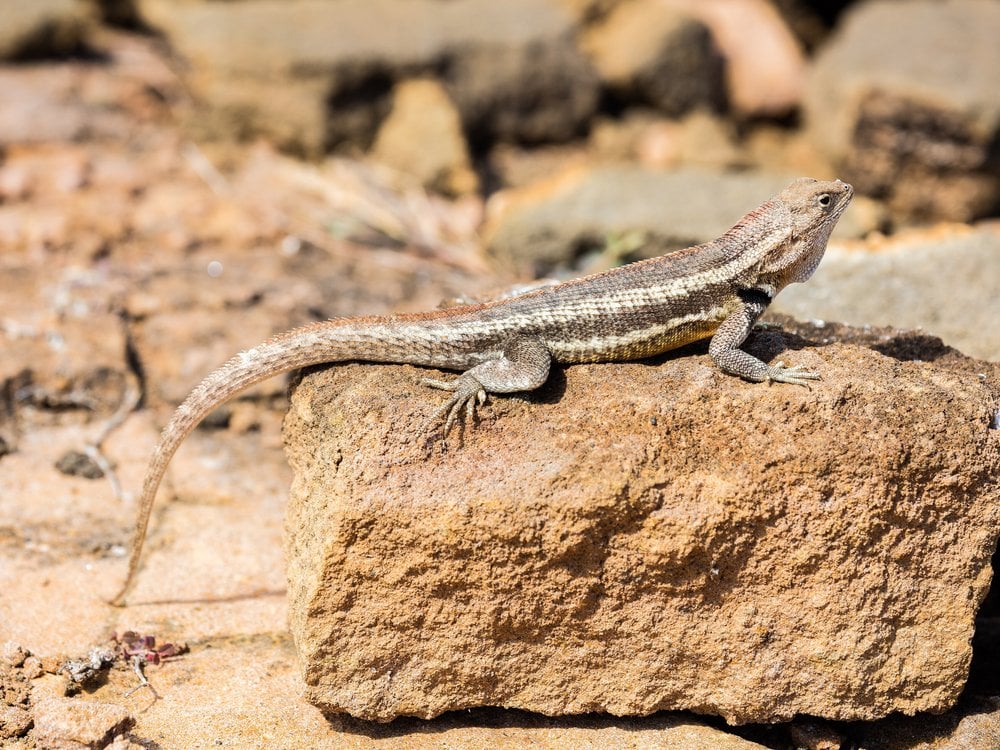
- Lava lizards: there are 7 species. They change color when threatened and can drop their tail to escape. Look on the trail to Tortuga Bay and on Santa Fe.
- Mockingbirds: 4 endemic species, often the first animals to greet you when you land. The Española mockingbird lives only on Española Island.
- Short-eared owl and vermilion flycatcher: watch for both on the Sierra Negra volcano hike on Isabela.
- Dolphins: bottlenose and common dolphins are the two seen most often, like on the boat crossing between Santa Cruz and Isabela.
- Mola mola: the ocean sunfish, seen by divers off Punta Vicente Roca.


Land tour, cruise or dive boat: which Galapagos wildlife each trip shows you
The animals you see depend on where you sleep. From hotels in Santa Cruz, Isabela, and San Cristóbal, a land-based trip reaches the tortoises, sea lions, marine iguanas, penguins, flamingos, and turtles. Day boats add North Seymour, Bartolomé, Santa Fe, or South Plaza.
A yacht cruise sails at night to the outer islands: Genovesa for red-footed boobies and fur seals, and Española for the waved albatross. A dive liveaboard is the only way to Wolf and Darwin and the western waters of the flightless cormorant.
On our trips, a naturalist guide authorized by the Galapagos National Park goes with you. The park entrance fee is US$ 200 per person, paid in cash on arrival.


Seeing Galapagos Islands animals with PlanetaEXO
After discovering so many incredible species that live in the Galapagos Islands, why not see them with your own eyes?
PlanetaEXO is an ecotourism platform specializing in Ecuador tours, from island hopping by land to a week of diving at Wolf and Darwin. We work with local operators and book the flights, boats, and hotels as one plan, so you can focus on the animals and not the logists. Contact us now!
Keep reading

November 5, 2026
Best Time to Visit Patagonia: Torres del Paine Month by Month
The best time to visit Torres del Paine in Chilean Patagonia, month by month, with daylight, temperatures, wind, and park rules for the W and O treks.

November 4, 2026
10 Facts About Salkantay Mountain, the Sacred Peak on the Way to Machu Picchu
A sacred Andean apu, South America’s only bear, breathtaking glaciers, and a hidden view of Machu Picchu. Learn 10 facts about Salkantay Mountain!
November 4, 2026
How Much Does It Cost to Visit the Amazon Rainforest in Brazil?
Understand Amazon tour prices in Brazil for different travel styles. See what’s included and what’s excluded and how to plan a cost-effective trip!