
From flexible necks to ancient legends, discover what makes the largest freshwater dolphin in the world one of the Amazon’s most surprising creatures
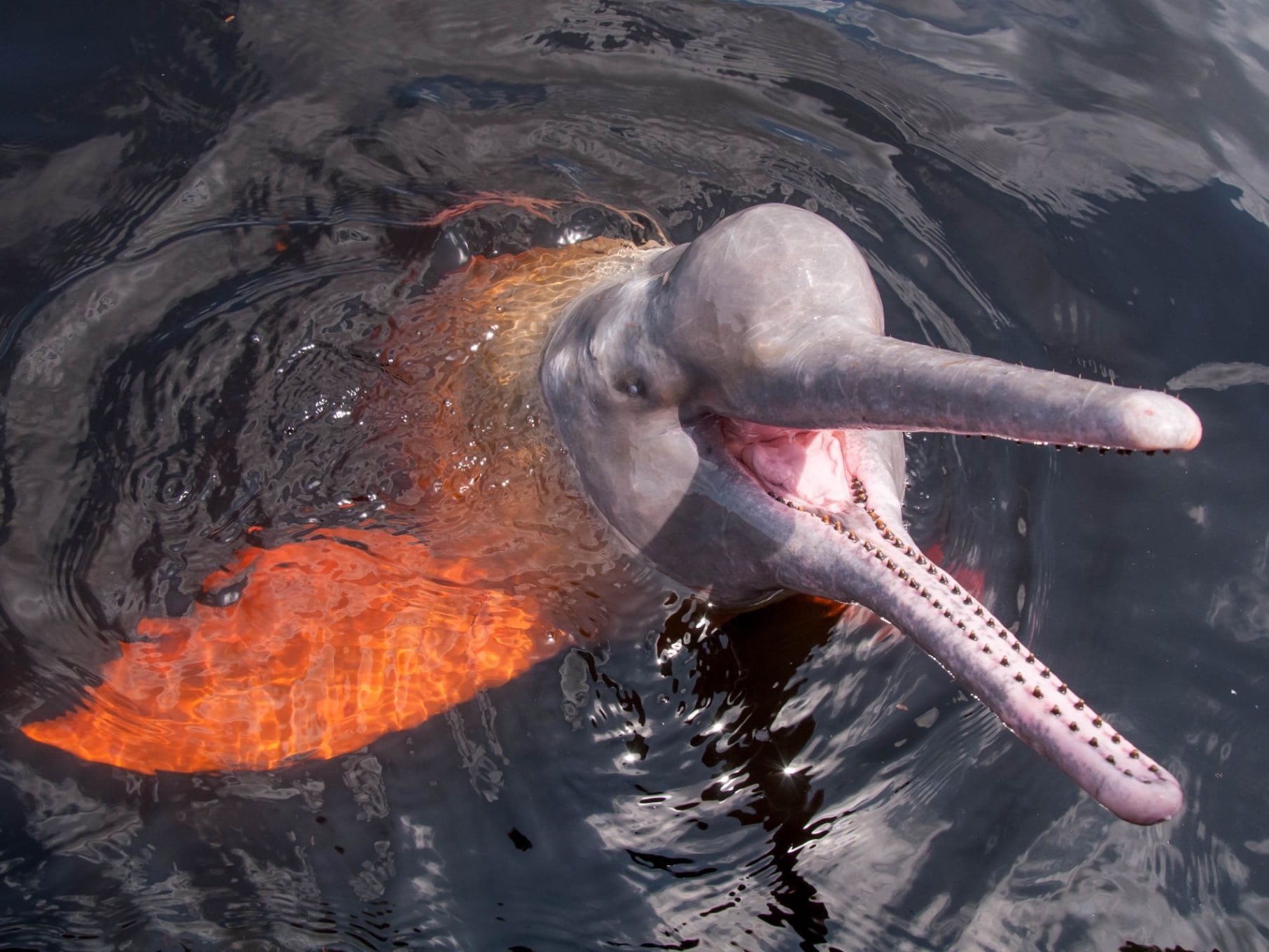
The Amazon pink river dolphin (Inia geoffrensis) is one of the most distinctive mammals of South America. Found across six countries in the Amazon and Orinoco basins, the species has been studied for over two decades by researchers at the Mamirauá Reserve in Brazil, who individually identified more than 650 animals over a 25-year period.
Its biology is remarkable: an unfused neck that turns 180 degrees, a diet covering more than 53 fish species, a long curved beak with molar-like teeth, and a body that shifts from grey at birth to bright pink in adulthood. The species has been classified as endangered on the IUCN Red List since 2018, with populations declining roughly 50% over 75 years.
Want to know what makes this animal so unique? PlanetaEXO, an ecotourism platform specializing in Amazon Rainforest tours in Brazil, has put together a list of 10 fascinating facts about the Amazon pink river dolphin. Check it out below!
1) Found in All Countries of the Amazon Basin
The Amazon pink dolphin inhabits the rivers of six South American countries: Bolivia, Brazil, Colombia, Ecuador, Peru, and Venezuela—a freshwater range covering approximately 7 million km², according to the Animal Diversity Web (University of Michigan).
The species lives in the Orinoco and Amazon river basins, including major tributaries like the Solimões, Negro, Madeira, Tocantins, Araguaia, and Putumayo. The species is also entirely freshwater, as they never enter salt water and are found thousands of kilometers from the sea.
But where do pink river dolphins live? They occupy main river channels in the dry season and move into the flooded forest (várzea) during the wet season, when water levels rise up to 10–12 meters and submerge vast areas of the rainforest.
👉 Read more: How to Get to the Amazon Rainforest in Brazil?
2) Echolocation System is Built for Muddy Water
Amazon waters are murky year-round, so the dolphin relies on biosonar rather than vision, emitting a high frequency that clicks through an organ on its forehead called the melon, which acts as an acoustic lens to focus sound.
According to One Earth, the species can produce 30 to 80 clicks per second when locating prey, and the echoes return through the dolphin’s lower jawbone to the inner ear.
A 2017 study published in ScienceDirect found that echolocation click parameters (peak frequency, bandwidth, and inter-click interval) differ significantly across dolphin populations in the Orinoco, Madeira, Xingu, and Araguaia basins, suggesting different evolutionary lineages.
River dolphins use shorter-range, lower-amplitude clicks than their marine cousins, an adaptation to shallow waters with high acoustic clutter from submerged vegetation.
3) The Largest Freshwater Dolphins in the World
Amazon pink river dolphin males can reach 2.55 meters in length and 207 kg (averaging 2.32 m and 154 kg), while females are smaller, up to 2.18 m and 154 kg. This makes the boto the largest of all river dolphins worldwide, beating the Ganges, Indus, Yangtze, and La Plata species.
It is also one of the most sexually dimorphic cetaceans, with males being 16% longer and 55% heavier than females. Interestingly, it is also one of the rare river dolphin species where males are larger than females—in other species, females are usually the bigger sex. Researchers Martin and da Silva, in their 2006 study published in Marine Mammal Science, linked this dimorphism to male-male competition and territorial fighting.
4) Color Changes with Age, Temperature, and Even Mood
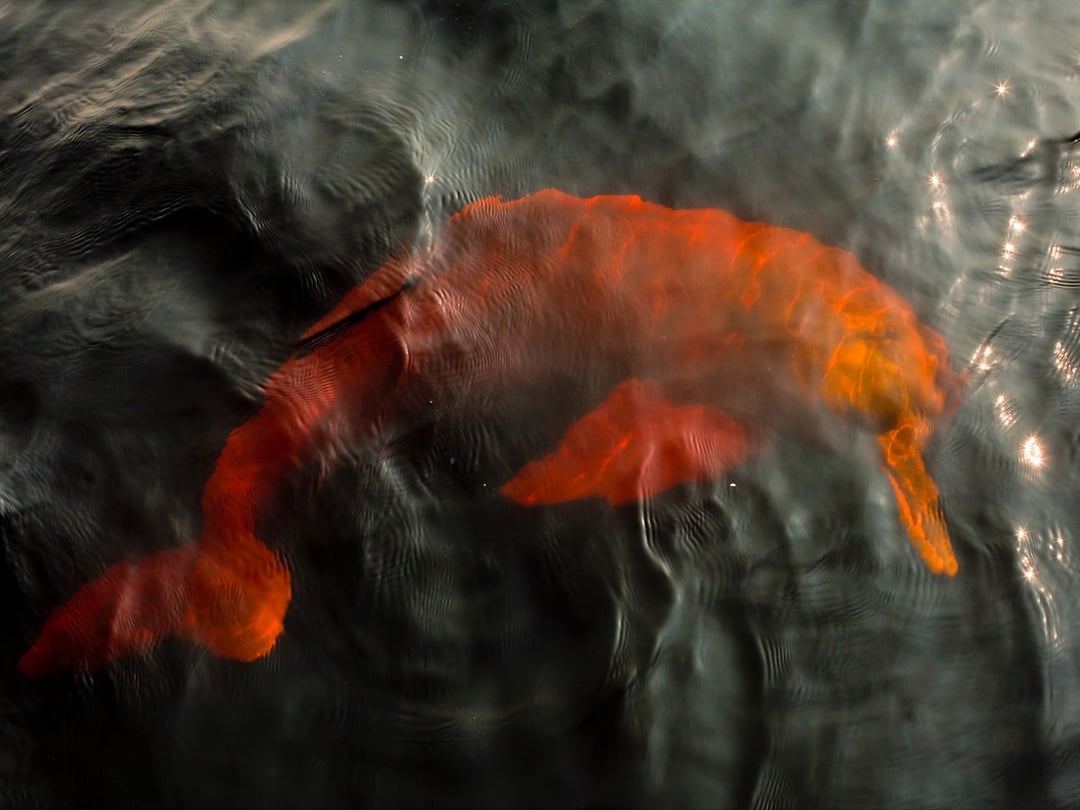
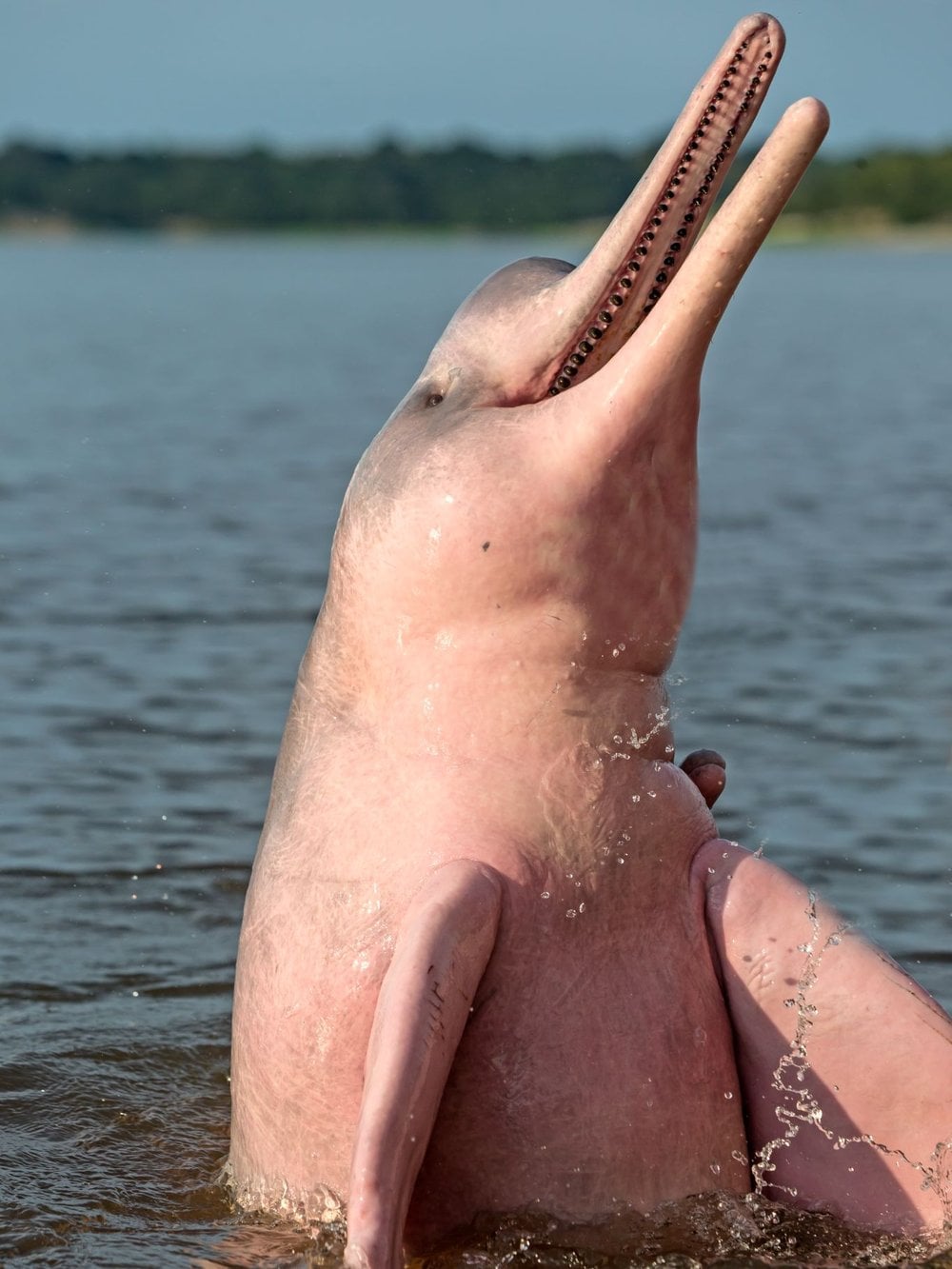
Why are Amazon river dolphins pink? It’s a combination of several factors. They are actually born grey and gradually turn pink as their skin becomes thinner and translucent, allowing the blood capillaries near the surface to show through.
The color is also linked to thermoregulation, scarring from social fights, water chemistry (especially iron content), and water temperature. Adult males tend to be significantly pinker than females as a result of aggressive male-to-male combat, which causes scarring that adds to the pink hue over time.
Like a human face flushing red, their skin can also temporarily turn bright pink when the animal is excited, exerting itself, or in social interaction. Some adults are nearly white, others almost entirely pink, and no two individuals look the same.
👉 Read more: When is the Best Time to Visit the Amazon Rainforest in Brazil
5) The Boto Goes by Many Names Across the Amazon
In Portuguese-speaking Brazil, the Amazon river dolphin is called boto-cor-de-rosa, boto-vermelho, boto-rosa, boto-malhado, or simply boto.
Among indigenous communities, the Tupi name uauiará (or uiara) refers to the dolphin as a kind of “water being” or protector of women—a sacred figure long before European colonization arrived.
The Tikuna people of the Colombia-Brazil-Peru border region call the pink dolphin omacha, which is also the name of the Colombian foundation founded by biologist Fernando Trujillo (National Geographic Explorer of the Year).
In Spanish-speaking countries, the dolphin is most commonly known as bufeo, bufeo colorado, tonina, or delfín rosado. In Peru, Colombia, and Ecuador, bufeo colorado is the standard local term; in the Orinoco region of Venezuela, tonina prevails.
Each name reflects a different cultural lens. Portuguese settlers chose boto (likely from the late Latin buttis, “rounded vessel,” referring to the dolphin’s bulbous head), while indigenous names emphasize the boto’s spiritual and mythological role rather than its physical appearance.
6) The Legend of the Boto is One of the Most Famous Brazilian Myths
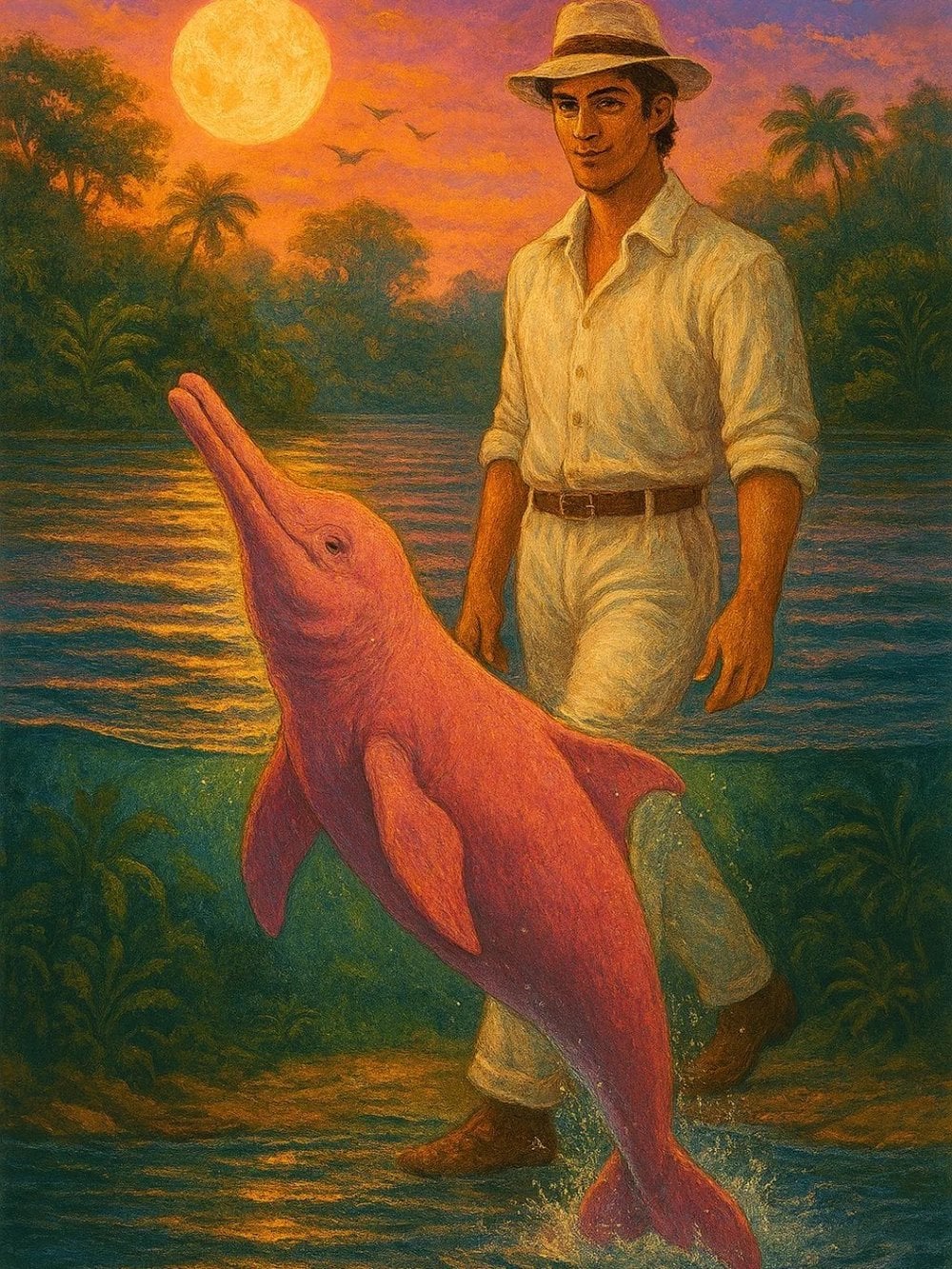
One of the most fascinating facts about Amazon pink river dolphins is actually a popular myth. In Brazilian folklore, the boto cor-de-rosa is one of the most enduring legends of the Amazon, a story of indigenous origin that has been passed down for centuries.
According to the tradition, on the nights of the Festas Juninas (Brazil’s traditional June festivities), the dolphin emerges from the river transformed into a tall, charming young man dressed in white and wearing a hat, which hides the blowhole that does not disappear during the transformation. He then seduces a young woman from the village, dances with her, and disappears back into the river by dawn—sometimes leaving her pregnant.
The legend has historically been used in the Amazon to explain pregnancies of unknown paternity, and it has also been featured in Brazilian media, including the 1987 film “Ele, o Boto,” the soap opera “A Força do Querer” (2017), and the Netflix series “Cidade Invisível” (2021).
👉 Read more: Best Amazon Jungle Lodges in Brazil
7) Impressive Brain Capacity
The Amazon pink dolphin has the largest brain among all freshwater dolphin species, and several tourism and conservation sources cite that its brain capacity is up to 40% larger than a human’s (a figure popularized in conservation outreach).
The more rigorous scientific picture: dolphins as a group have one of the highest encephalization quotients (EQ) among non-human animals, second only to humans, according to Marino et al. (2004) and Montgomery et al. (2013).
In practice, that intelligence translates into clear behaviors: complex acoustic communication using both echolocation clicks and whistles, object play (they have been observed carrying sticks, branches, and turtles), problem-solving, and curiosity around boats and swimmers.
Studies suggest that male botos may also engage in a form of social display by carrying objects in their mouths during courtship—a behavior so far described in no other cetacean.
8) Underwater Gymnasts (with Anatomy to Match)
Unlike marine dolphins, the Amazon river dolphins have unfused cervical vertebrae (the seven neck bones are not welded together), which allows them to turn their heads up to 180 degrees, according to Whale and Dolphin Conservation.
This flexibility is essential for navigating the flooded forest of the Amazon, where submerged tree trunks, roots, and branches block straight-line swimming. The species also lacks a typical dorsal fin, replaced by a low dorsal ridge that helps it weave through dense vegetation.
Pink river dolphins can swim forward with one flipper while paddling backward with the other, turning with surgical precision around obstacles. They are also frequently observed swimming upside down, possibly to see the river bottom better through their small eyes.
Cruising speed is between 8 and 13 km/h, with bursts of up to 24 km/h—slower than ocean dolphins, but compensated by extreme maneuverability among trees and roots.
👉 Read more: 15 Amazon Animals – Unravel the Wildlife in Brazil
9) One of the Most Varied Carnivorous Diets of Any Toothed Whale
So, what do pink river dolphins eat? The boto has one of the widest-ranging diets among all toothed whales, feeding on up to 53 different species of fish, including croakers, catfish, tetras, piranhas, and characins. The species also consumes river turtles, freshwater crabs, aquatic frogs, and freshwater mollusks.
Its narrow jaw contains 25 to 28 pairs of teeth, divided between sharp conical teeth at the front (for catching prey) and molar-like teeth at the back—a feature unique among dolphins, allowing the boto to crush hard prey like turtle shells and armored catfish.
This dietary flexibility is critical: during the wet season, fish disperse into the flooded forest, and it hunts alone in vast submerged territories; during the dry season, prey concentrates in main channels and confluences, where up to 35 dolphins have been observed cooperatively herding fish.
10) Friendly with Humans, Yet Solitary by Nature
Despite their famously curious and playful personality around boats, swimmers, and children, pink river dolphins are largely solitary animals. They are mostly often spotted alone or in small groups of 2 to 4 individuals, usually a mother with her calf. This is very different from ocean dolphins, which can travel in pods of dozens or even thousands.
Researchers believe this solitary lifestyle is linked to two factors: the boto has no significant natural predators once adult (only caimans, jaguars, and anacondas occasionally take young animals), and the structure of the flooded forest favors individual hunting over coordinated pod attacks.
Larger aggregations of up to 35 dolphins only form temporarily at river confluences when prey concentrates seasonally. Their curiosity with humans is well documented in the Cuyabeno Wildlife Reserve (Ecuador) and the Mamirauá Reserve (Brazil), where botos have been filmed approaching kayakers, leaping near boats, and interacting with local children.

👉 Read more: Best Amazon River Cruises in Brazil
Visiting the Amazon and meeting pink river dolphins with PlanetaEXO
Now that you know the most fascinating Amazon pink river dolphin facts, it’s time to see this incredible animal up close. The boto can be spotted year-round in several Brazilian Amazon destinations, especially around Manaus, the Rio Negro, the Anavilhanas archipelago, and the Mamirauá Sustainable Development Reserve.
PlanetaEXO is an ecotourism platform specializing in Amazon Rainforest tours in Brazil, working alongside the best local operators in the region. From jungle lodges deep in the rainforest to wildlife-focused river cruises, our team is here to help you plan a hassle-free trip. Contact us now!
Keep reading
October 14, 2026
10 Tips to Make the Most of Your Amazon Tour From Manaus, Brazil
Booked an Amazon tour from Manaus in Brazil? See 10 tips to enjoy your experience, including what to eat, what to do, how to be safe, and what to avoid!

October 1, 2026
PlanetaEXO’s new mini-doc showcases ecotourism in Lençóis Maranhenses
In “Lençóis Maranhenses: Far From The Crowds, Close To What Matters”, PlanetaEXO’s mini-doc shows how ecotourism is changing life for local communities.
September 30, 2026
Best Dive Sites in Fernando de Noronha: 21 Spots by Depth and Level
The 21 best dive sites in Fernando de Noronha, with depth, seaside, and level for each, from 8 m beginner reefs to the 62 m Corveta Ipiranga wreck.