
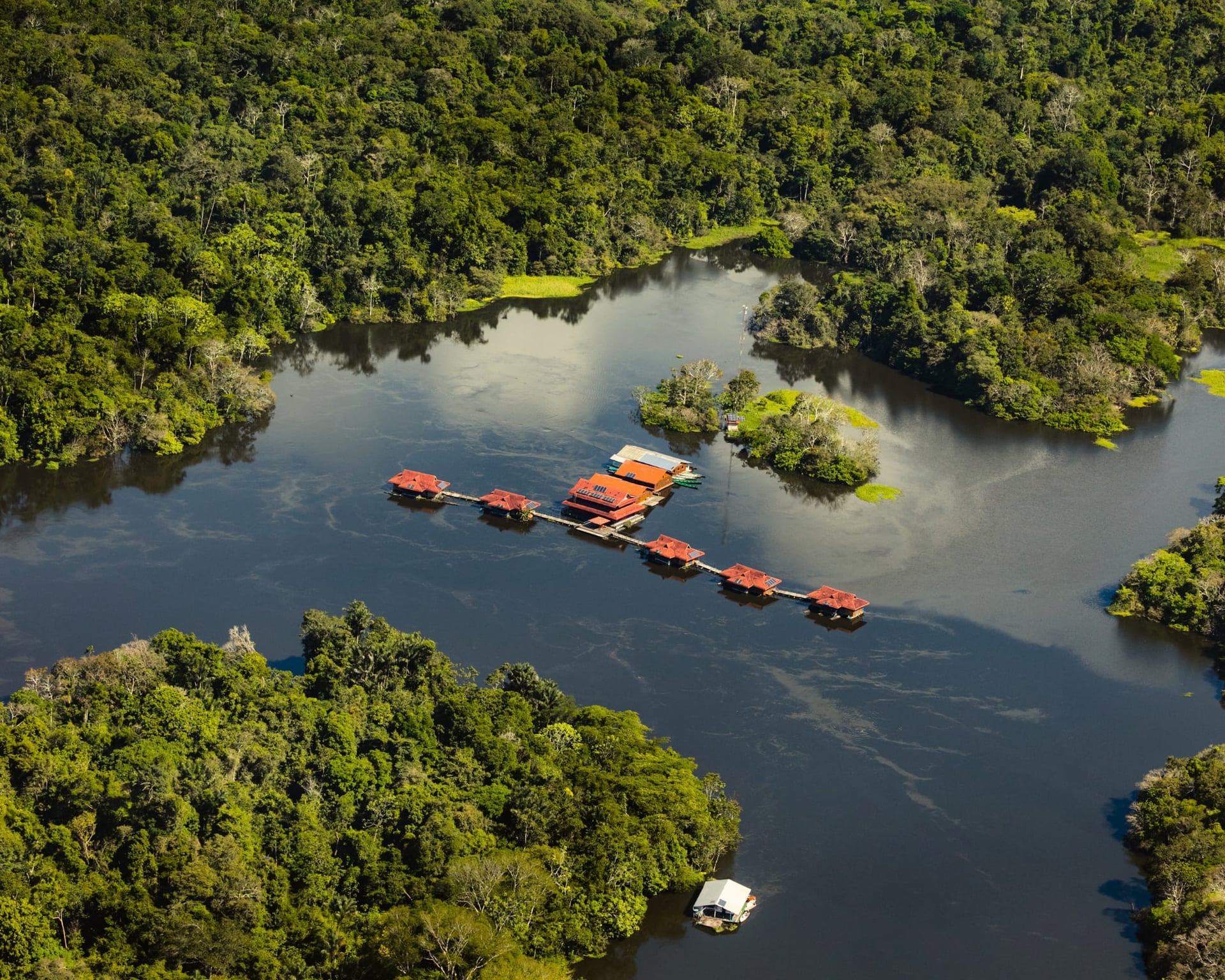
From a scientist’s search for a rare monkey to a lodge that floats on the river itself, here are a few facts about Uakari Lodge, deep inside Brazil’s Mamirauá Reserve
On a stretch of the Solimões River near Tefé, deep in the Brazilian Amazon, sits one of the region’s most unique places to sleep: a lodge built entirely on water. Uakari Floating Lodge sits inside the Mamirauá Sustainable Development Reserve, a 1,124,000-hectare protected area of várzea (flooded) forest, and rises and falls with the river by as much as 12 meters a year.
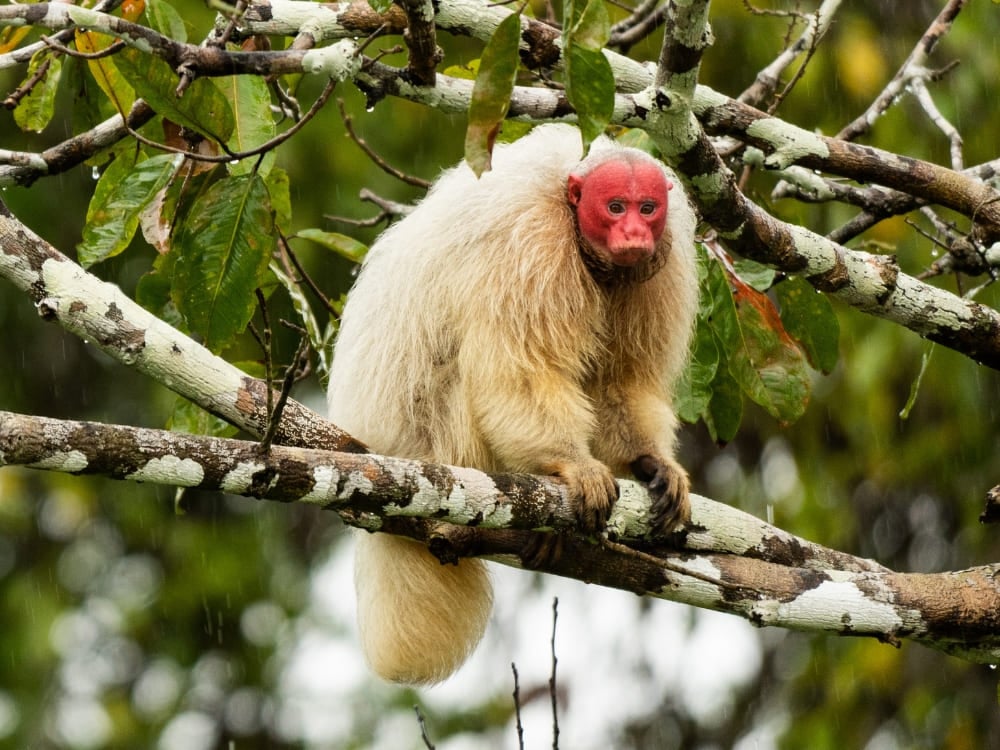
Named after the striking, red-faced monkey that calls this forest home, the lodge has operated for close to three decades as one of the Amazon’s earliest examples of community-based tourism, co-managed by a federal research institute and the riverside communities who actually live here.
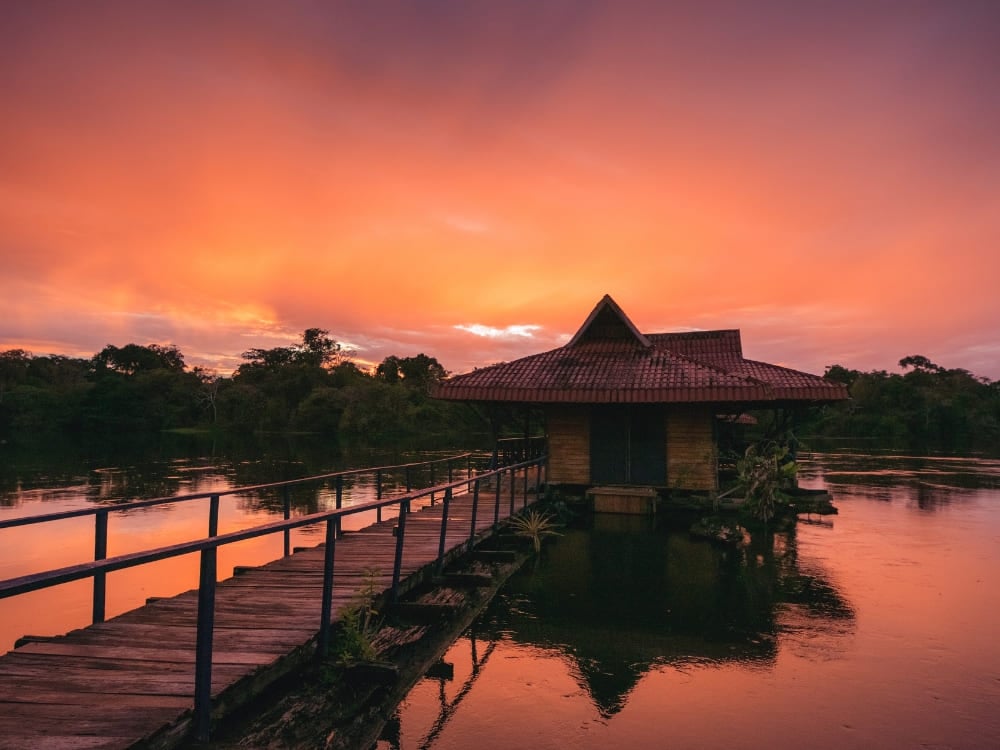
Curious what makes a floating hotel inside a protected reserve worth the trip up the river? PlanetaEXO, an ecotourism platform specializing in Amazon Rainforest tours in Brazil, has put together these 8 facts about Uakari Lodge. Check it out below!
1. Uakari Floating Lodge exists because a scientist went looking for a rare monkey
Brazilian primatologist José Márcio Ayres traveled to the region in the 1980s specifically to study the white uakari monkey, the same animal the lodge is named after, and found the area threatened by unregulated exploitation.
Driven by a vision to safeguard the regional ecosystem, he proposed creating a protected sanctuary in 1985. This initiative spurred the establishment of the Mamirauá Ecological Station in 1986, followed by the founding of the Instituto Mamirauá in 1998, the federal research institute responsible for managing the lodge to this day.
Ayres earned his PhD at Cambridge with a doctoral thesis on uakaris and the Amazon flooded forest, based on fieldwork near Tefé. Uakari Lodge emerged directly from this research around 1998, expanding upon a floating research laboratory operated by the Institute within the reserve. For nearly 30 years, the lodge has hosted visitors while continuously reinvesting tourism revenue into local community projects.
👉 Read more:
- When is the Best Time to Visit the Amazon Rainforest in Brazil
- How to Get to the Amazon Rainforest in Brazil?
2. Floating foundations built from one of the Amazon’s lightest trees
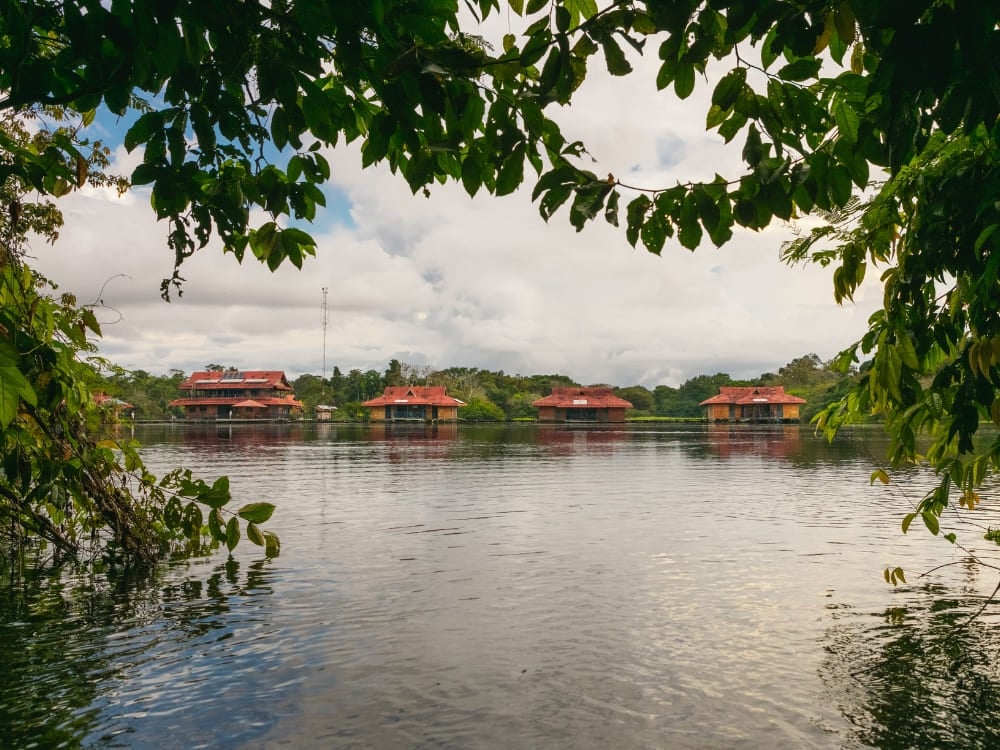
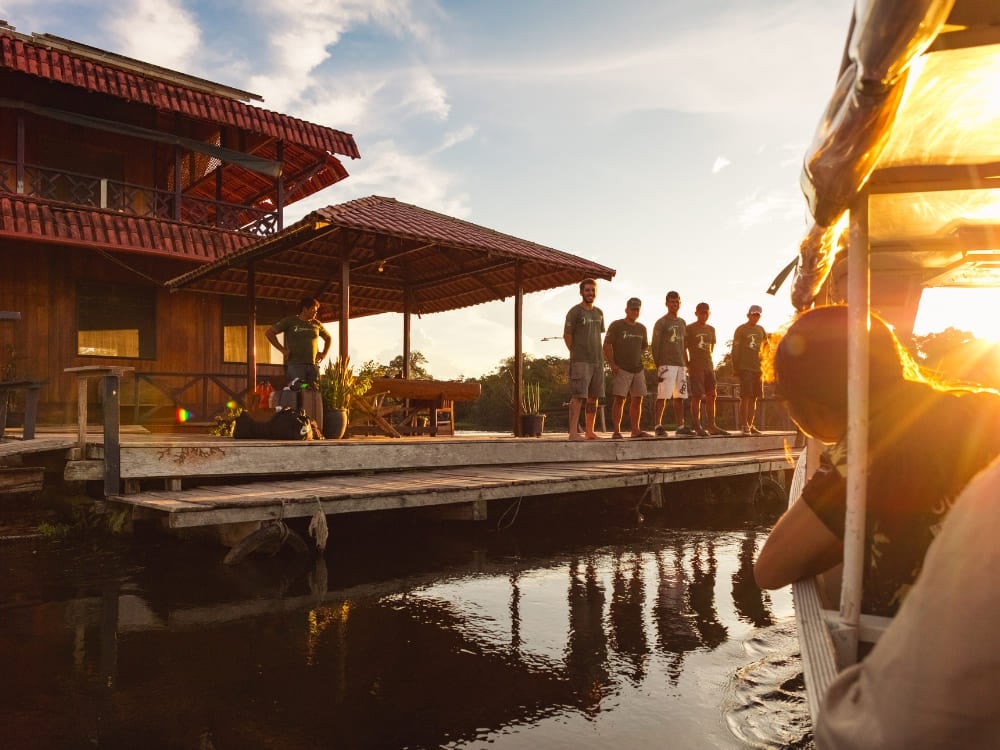
Uakari Lodge does not sit on stilts like most riverside builds; it actually floats.
The structures rest on massive logs of assacu (Hura crepitans), a native Amazon tree that can grow over 30 meters tall and has an unusually low wood density (around 0.36–0.38 g/cm³), light enough to keep an entire building buoyant on the river.
The design itself came from inside the reserve, developed jointly by researchers at the Instituto Mamirauá and AAGEMAM, the local riverside guides’ association, applying traditional Amazonian floating-construction knowledge to a modern guest lodge.
👉 Read more: Best Amazon Jungle Lodges in Brazil
3. Run by a research institute and the local community
Uakari Floating Lodge is owned by the Instituto Mamirauá, formally founded in 1999 as a federal research body linked to Brazil’s Ministry of Science, Technology, and Innovation.
Day to day, it is co-managed with AAGEMAM, the association representing the reserve’s riverside communities, giving local people a direct stake in how their own protected area receives visitors.
This environmental protection is backed by significant institutional recognition. Encompassing 1,124,000 hectares of flooded várzea forest where the Solimões and Japurá rivers meet, the Mamirauá Sustainable Development Reserve was recognized as a Ramsar Wetland of International Importance in 1993. Later, in 2003, its Demonstration Area was incorporated into the Central Amazon Conservation Complex, a designated UNESCO World Heritage Site.
4. Pioneering spirit and river levels
Mamirauá became Brazil’s first-ever Sustainable Development Reserve, a protected-area category created specifically for it, when the law establishing it was signed on July 12, 1996.
Unlike blackwater regions, this white-water várzea floodplain experiences extreme seasonal shifts. Water levels fluctuate by approximately 10 to 12 meters from the low-water period (September to November) to the high-water period (May to July), with localized surges reaching up to 16 meters.
The forest around the lodge stays submerged for about four months of the year, which is exactly why Uakari needed to float in the first place.

👉 Read more: Best Amazon River Cruises in Brazil
5. A stay built around canoes, not roads
Since there are no roads through a flooded forest, every activity here runs by canoe or small boat, including trips through the flooded forest itself, night walks with caiman-spotting, traditional piranha fishing, pink river dolphin sightings, and a guided visit to one of the reserve’s own riverside communities.
Uakari Floating Lodge offers stays of 3, 4, or 7 nights, plus a dedicated 4-night birdwatching program for travelers chasing the reserve’s bird list specifically. Because it is a small, remote operation with just a handful of rooms, the hotel generally asks that children be over 10 years old.
Getting there takes some effort: travelers fly into Manaus, then take a roughly 1-hour domestic flight to Tefé, followed by a boat transfer of about 1.5 to 2 hours to reach the lodge itself.
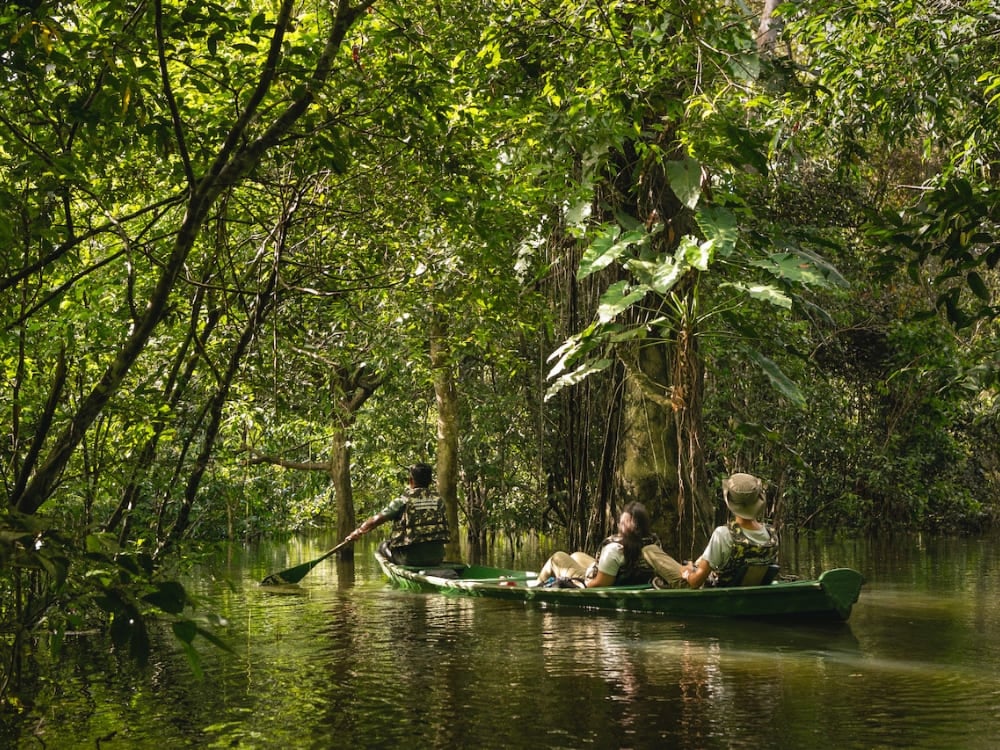
👉 Explore the adventure: Uakari Lodge – Amazon Rainforest Ecolodge Trip in Brazil
6. Sustainability efforts and awards
The lodge generates its own electricity from solar power, collects rainwater for guest use, and treats its wastewater before it ever reaches the river.
This commitment to sustainable community impact was globally honored in 2015. Uakari Lodge secured the Silver award for “Best for Poverty Reduction” at the World Responsible Tourism Awards, a distinction shared with only two other international finalists, celebrating a model designed to directly direct economic benefits back to local villages.


7. One of the best places on Earth to see the Amazon’s pink river dolphin
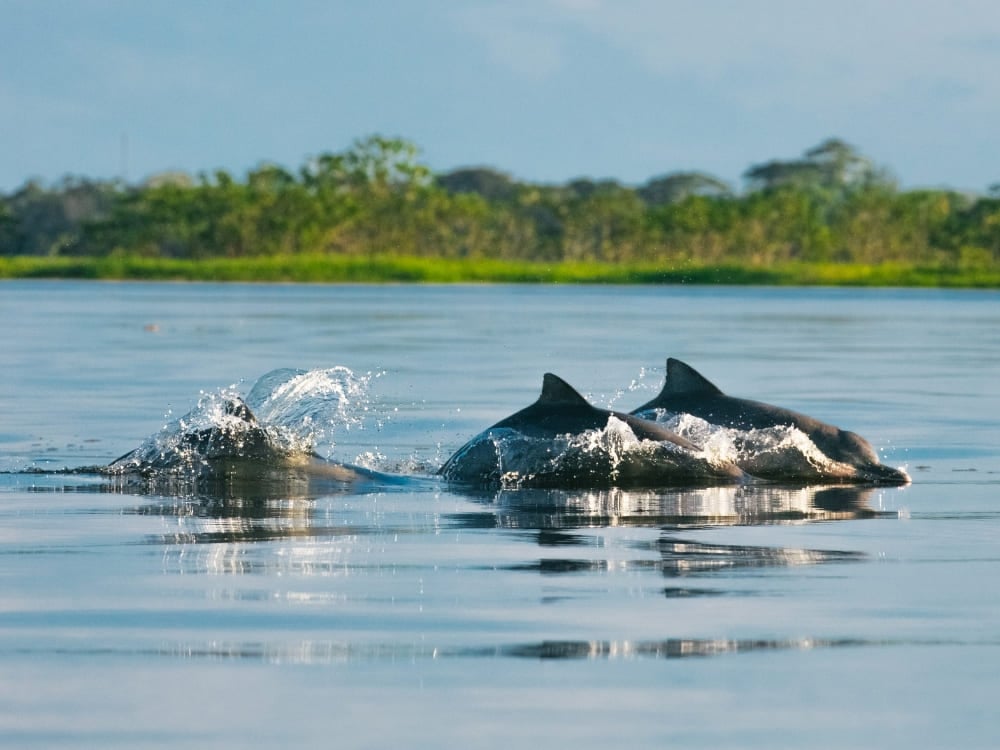
The waters around Uakari Floating Lodge hold some of the highest recorded densities of the Amazon pink river dolphin (boto-cor-de-rosa) found anywhere, up to 61 individuals per square kilometer in confluence areas, alongside 64 individuals per square kilometer of tucuxi, the smaller grey river dolphin.
Dolphins are far from the only wildlife on offer. The reserve is also home to jaguars, black caiman, sloths, coatis, and, of course, the lodge’s own namesake, the white uakari monkey, a species found almost nowhere else on the planet.
👉 Read more: 15 Amazon Animals: Unravel the Wildlife in Brazil
8. Uakari Lodge helped save one of the Amazon’s biggest fish from disappearing
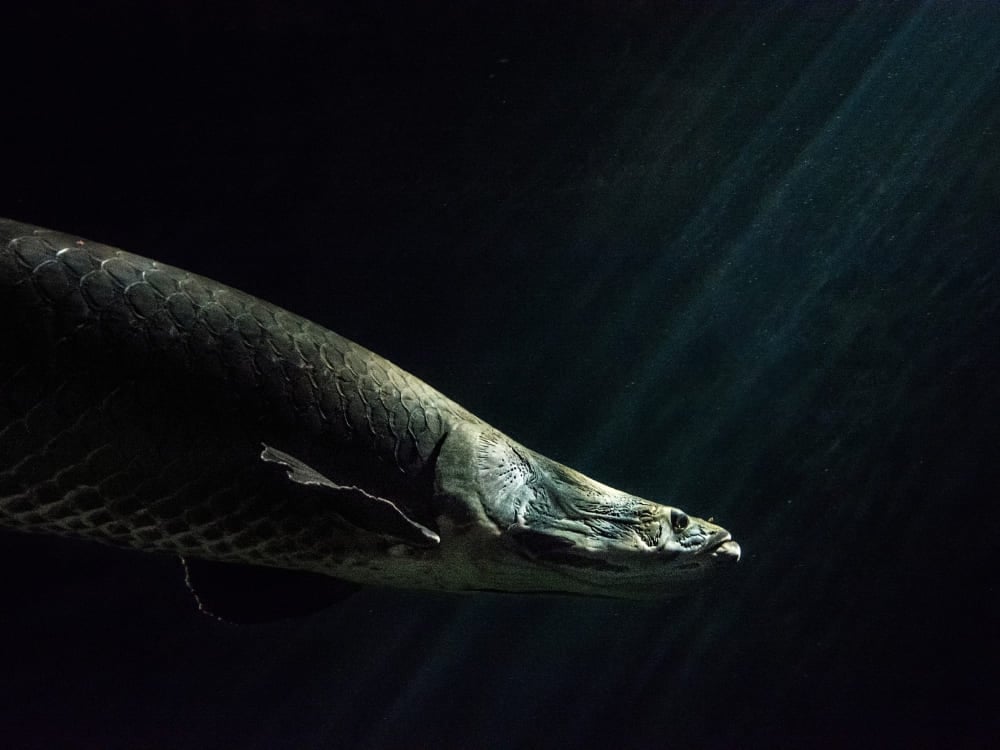
The Instituto Mamirauá’s participatory pirarucu (Arapaima) management program, developed alongside riverside communities, is one of the best-documented fish-recovery stories in the world.
Through local fisher self-enforcement and stock counts, managed lakes saw the pirarucu population surge from around 2,500 to over 190,500 by 2018, which played a pivotal role in removing the species from Brazil’s endangered list.
The model has since been replicated in other parts of Amazonas state, a direct outcome of the same conservation-through-tourism approach that built Uakari Lodge in the first place.
👉 Read more: Amazon Rainforest Conservation Efforts
Visiting Uakari Floating Lodge with PlanetaEXO
Now that you know how a scientist’s search for a rare monkey turned into one of the Amazon’s most community-driven lodges, the next step is seeing the Mamirauá Reserve for yourself.
As an ecotourism platform focused on travel experiences in ecolodges in the Brazilian Amazon, PlanetaEXO maintains a long-standing partnership with Uakari Floating Lodge. Working directly with local ground operators, our team creates tailor-made, hassle-free stays within the reserve. Contact us now!
Keep reading
October 14, 2026
10 Tips to Make the Most of Your Amazon Tour From Manaus, Brazil
Booked an Amazon tour from Manaus in Brazil? See 10 tips to enjoy your experience, including what to eat, what to do, how to be safe, and what to avoid!
October 1, 2026
PlanetaEXO’s new mini-doc showcases ecotourism in Lençóis Maranhenses
In “Lençóis Maranhenses: Far From The Crowds, Close To What Matters”, PlanetaEXO’s mini-doc shows how ecotourism is changing life for local communities.
September 30, 2026
Best Dive Sites in Fernando de Noronha: 21 Spots by Depth and Level
The 21 best dive sites in Fernando de Noronha, with depth, seaside, and level for each, from 8 m beginner reefs to the 62 m Corveta Ipiranga wreck.