
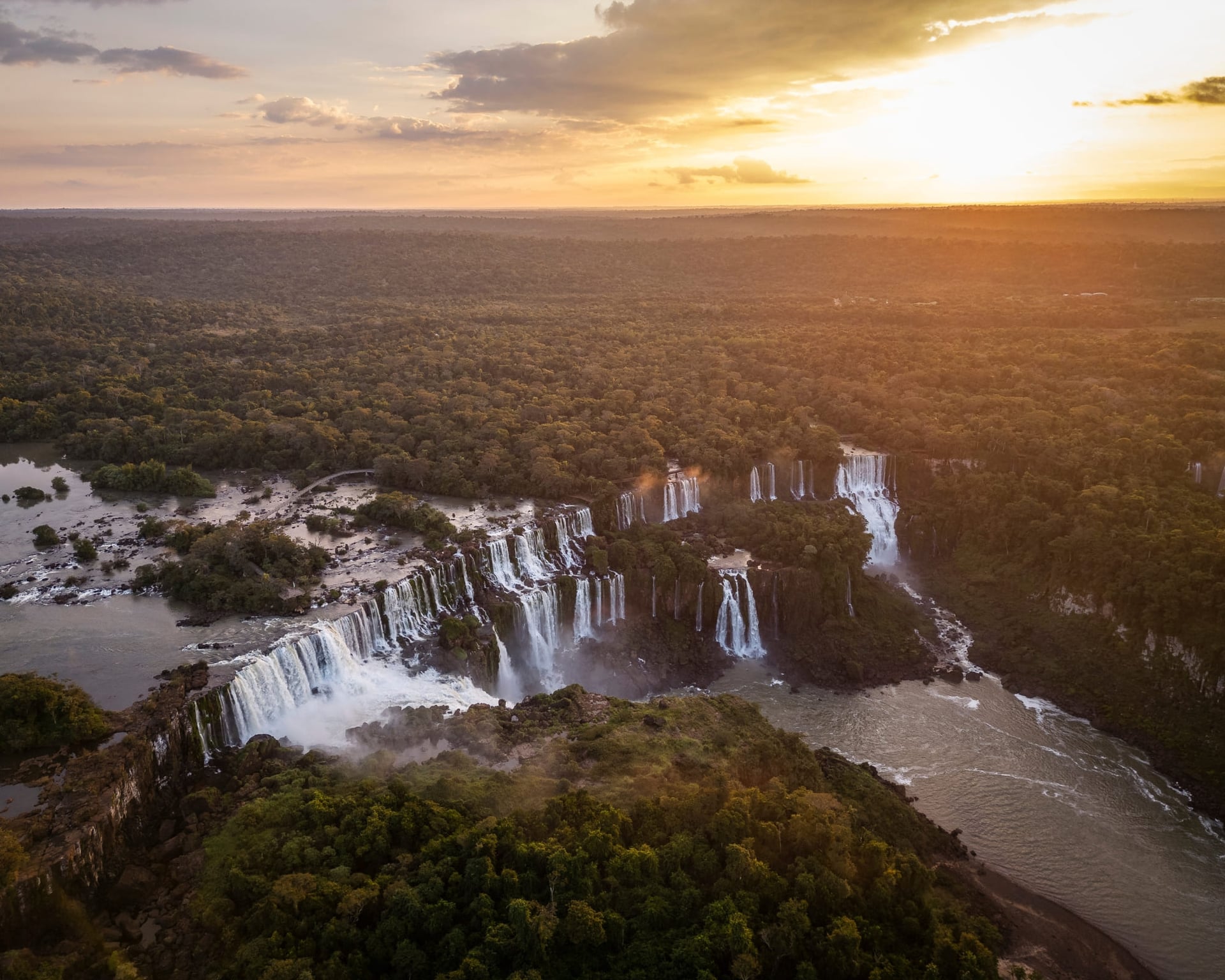
From the Guarani name behind the water to the lava that carved the canyon, here are 10 facts about Iguazu Falls, one of the most impressive waterfalls systems in the world
The Iguazu River begins in the Serra do Mar coastal mountains near Curitiba, then turns its back on the Atlantic and runs west for 1,320 kilometers across the state of Paraná. A few kilometers before it reaches the Paraná River, at the exact point where Brazil, Argentina, and Paraguay meet, it drops off the edge of a basalt plateau. That drop is Iguazu Falls.
Straddling the international boundary, the waterfall system is split in a surprisingly uneven manner: although the river flows through Brazilian territory for nearly its entire length, it forms the border only near its end, where Argentina holds nearly 80% of the falls and Brazil retains roughly 20%.
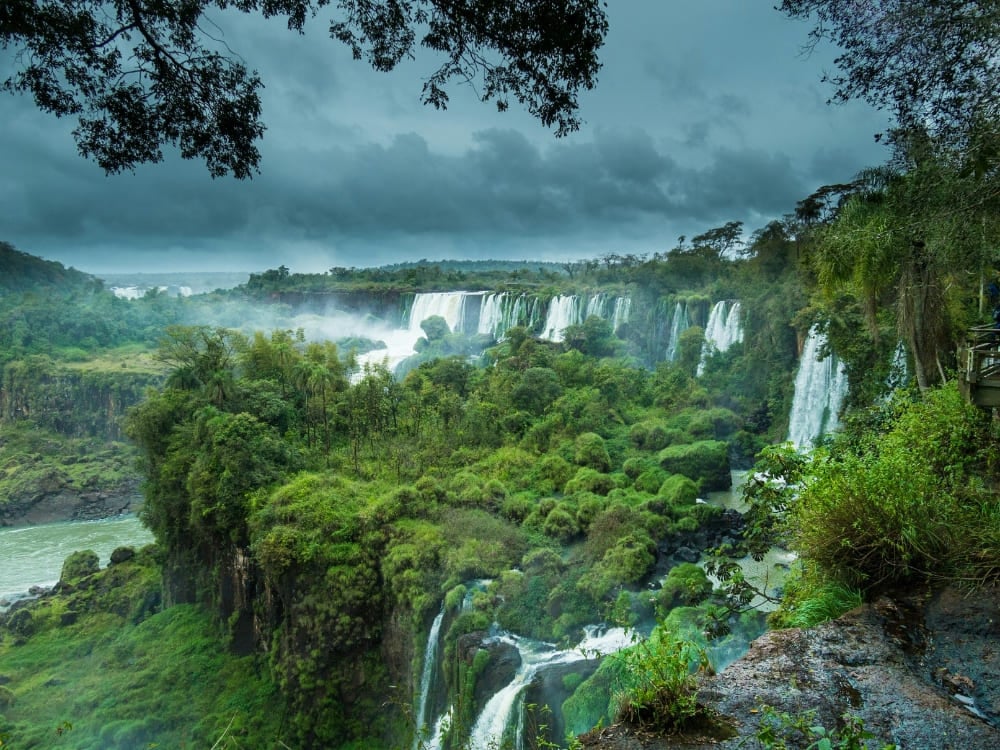
It is well-known that Argentina encompasses most of the actual cascades, while Brazil commands the sweeping panoramic views. So what else does a place this famous still keep quiet about?
PlanetaEXO, an ecotourism platform specializing in Iguazu Falls tours, has put together these 10 Iguazu Falls facts. Check it out below!
1. The meaning of “Iguaçu”
In Guarani, “y” means “water,” and “guasu” means “big.” Put the two together, and you get Iguaçu: big water. The people who lived along this river long before any map existed described it in two syllables, without a single adjective.
The spelling shifts with the border. It is Iguaçu in Portuguese, Iguazú in Spanish, and Iguassu in older English texts. The meaning never changes.
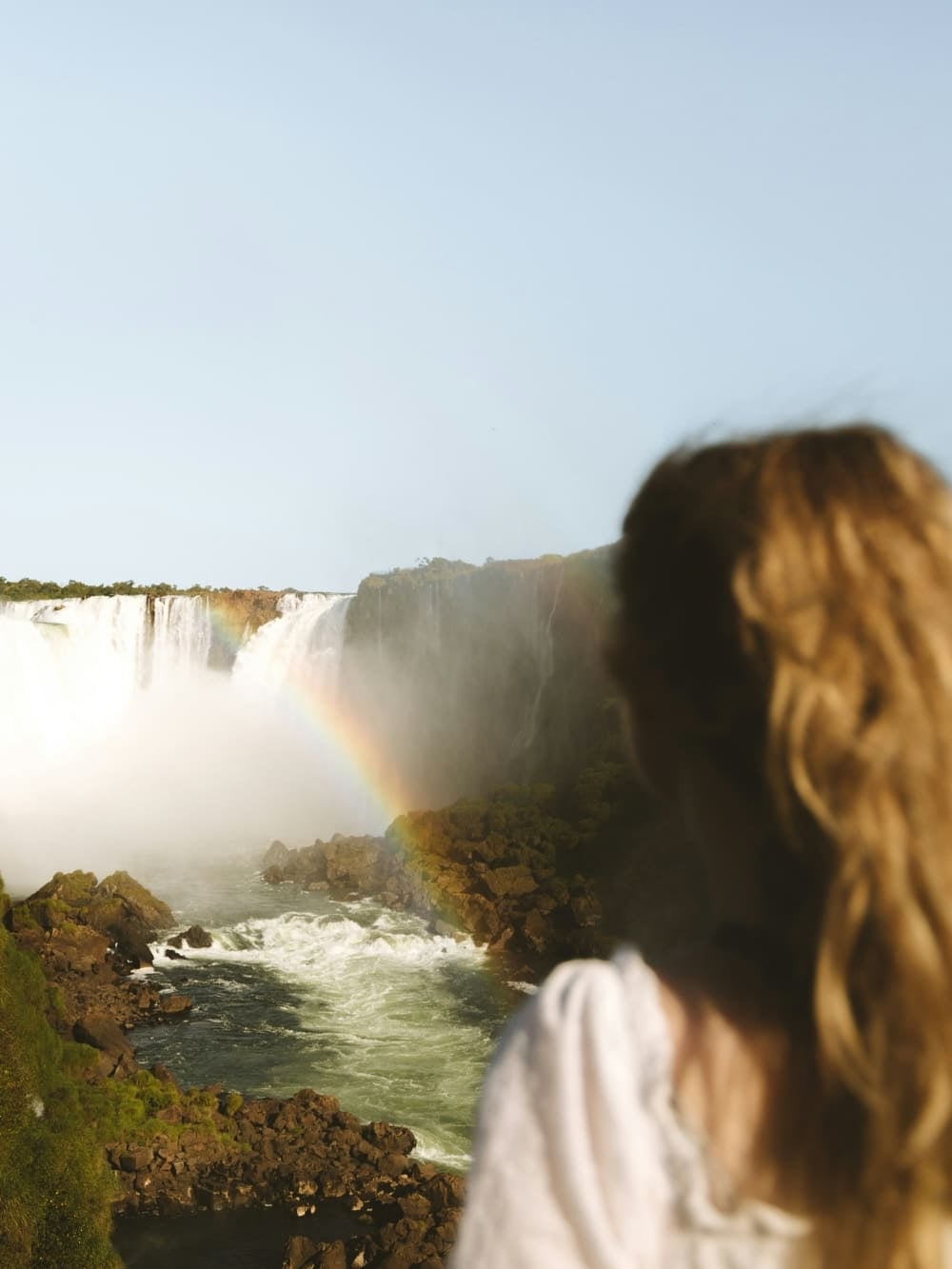
2. A Kaingang legend explains the falls as a wound in the earth
A folkloric legend of the Kaingang indigenous culture attributes the origin of the falls to a phenomenon caused by the fury of a serpent god, the son of Tupã, the creator god and lord of thunder in Tupi-Guarani mythology.
M’Boi, a serpent deity and guardian of the waters, demanded the sacrifice of a young woman every year. Naipi had been promised to him, but a warrior named Tarobá fell in love with her. During the ceremony meant to consecrate her, the two escaped downriver by canoe.
M’Boi found out. Enraged, he drove into the earth and twisted his body, tearing open an enormous fissure across the river, which caused the water to fall into it. Naipi was turned into one of the rocks at the center of the falls, struck by the current forever, while Tarobá became a palm tree leaning out over the gorge, close enough to see her and never close enough to reach her.
Read the next Iguazu Falls fact and you will notice how both the legend and the geology describe the same crack!
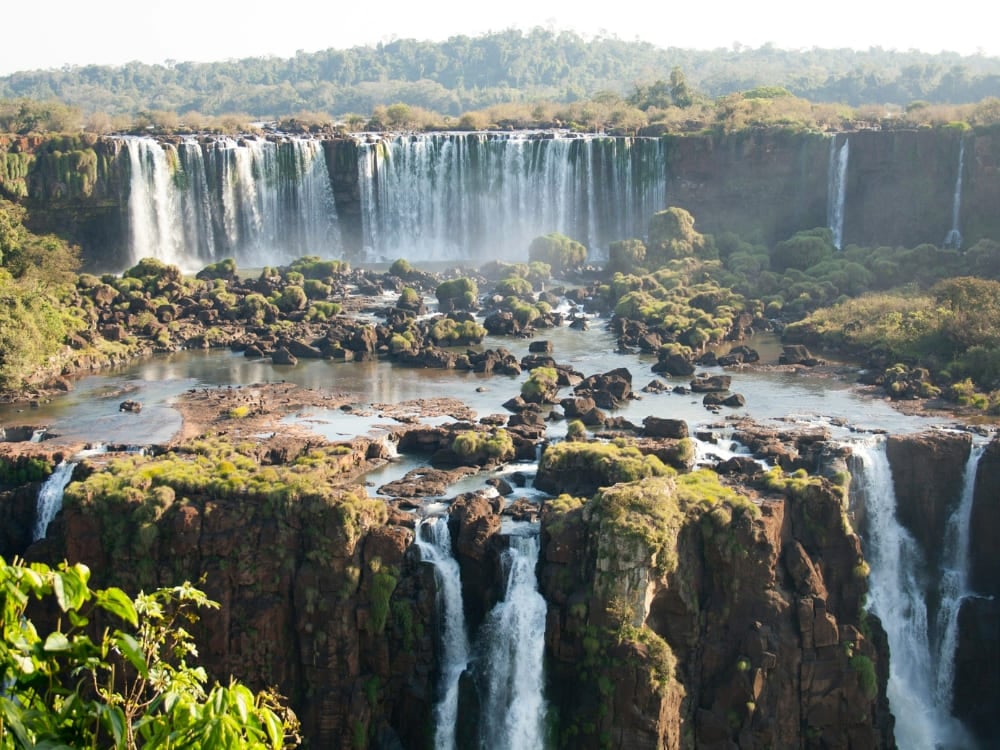

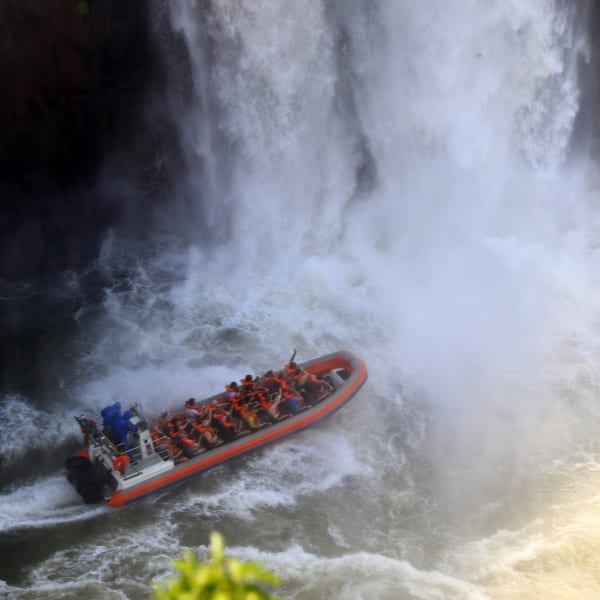
3. The falls were carved by one of the largest lava flows in Earth’s history
During the breakup of Gondwana and the opening of the South Atlantic, roughly 125 to 115 million years ago, massive continental fissures erupted with basaltic lava. The flows covered about 1.2 million square kilometers and stacked up to 1,500 meters thick.
That is the Serra Geral Formation, the largest basaltic lava flow recorded on continental crust. The same rock surfaces on the other side of the ocean, in Namibia, where it is called Etendeka.
Upon cooling, the lava effectively laid the foundation for the falls. As basalt cools, it fractures vertically into distinct columns and separates horizontally between successive lava flows. A sturdy 8- to 10-meter cap stone sits atop the geological structure, protecting the more easily eroded layers beneath. As water infiltrates these vulnerable seams, it gradually undercuts the base until the hard upper shelf collapses in large blocks.
That is a waterfall described mechanically: not water wearing rock down evenly but pulling one layer out from under another. The Kaingang story says the earth was torn open. The basalt agrees.

4. Wider and taller than Niagara, and once 26 times stronger than itself
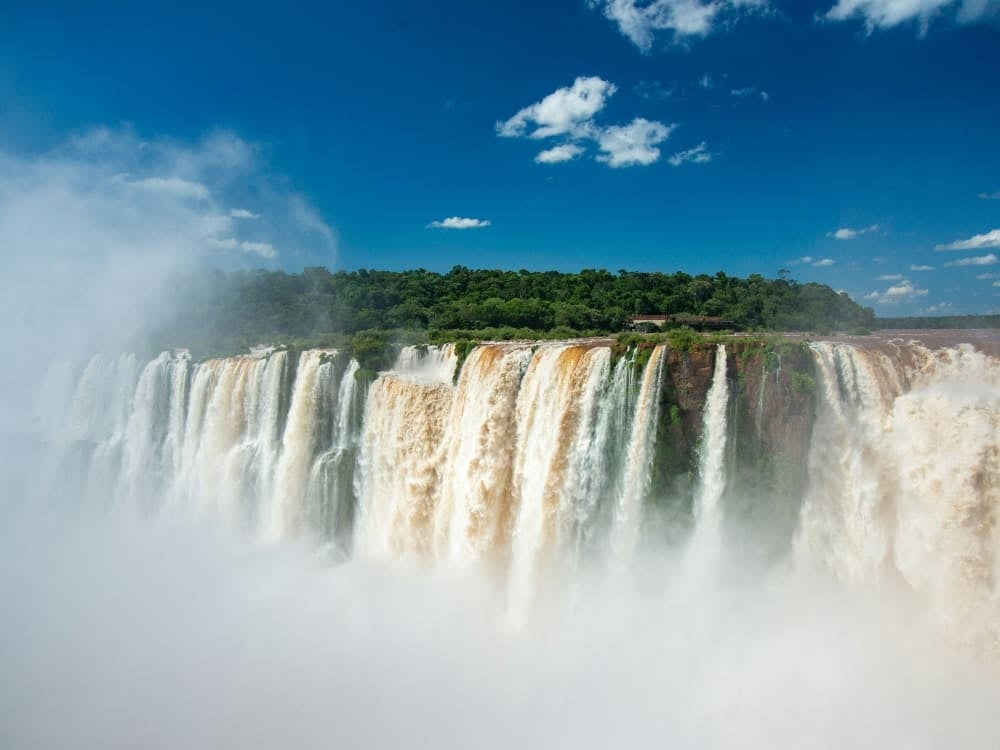
Iguazu has a standard number of 275 waterfalls along a 2.7-kilometer front, with the Devil’s Throat (Garganta do Diabo) dropping 82 meters. Set that against Niagara Falls at 1.2 kilometers wide and roughly 50 meters tall, or Victoria Falls at more than 1.6 kilometers.
Those 275 falls, however, are an average dressed-up fact. The real count moves between 150 and 300 depending on the river. In a dry month, minor cascades thin to a trickle and disappear. In a flood, separate falls merge into one continuous curtain. In other words, you do not see the same waterfall the visitor before you saw.
The flow says it more bluntly. The average is 1,746 cubic meters per second. On June 9, 2014, the Iguaçu River pushed 45,700 cubic meters per second over the edge. That is twenty-six times its own average and about nineteen times what Niagara moves on an ordinary day.
Iguazu is more than half again as tall as Niagara. The difference is so significant that former US first lady Eleanor Roosevelt, in a visit in 1944 to Brazil, allegedly exclaimed, “My poor Niagara!” when she first saw the magnitude of Iguazu.
5. A bird flies straight through the waterfall to sleep behind the falls
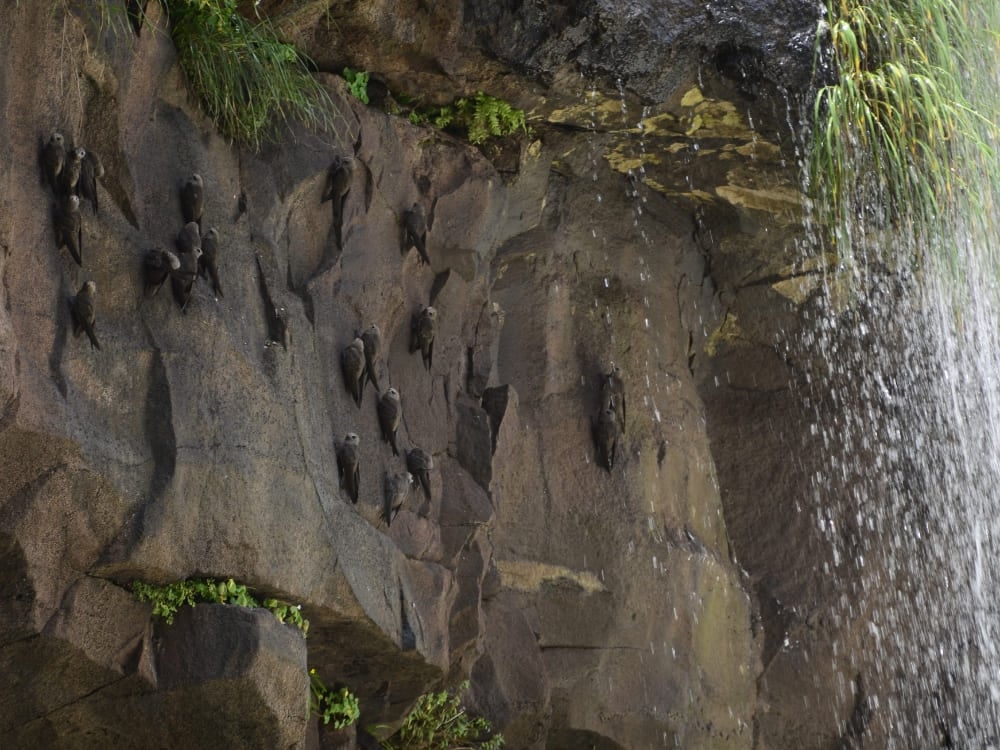
The great dusky swift (Cypseloides senex) is about 18 centimeters long and does something that looks like a mistake. At dusk, it accelerates toward the falls and disappears into the white curtain, then later comes back out of what appears to be solid water.
Behind the sheet, on wet vertical rock, it builds a flat, disc-shaped nest of moss and small stones cemented with mud and lays a single egg. The colonies cling to cliffs beside and behind the falling water. The logic is defensive: a wall no climbing predator can scale, screened by water no flying predator will cross.
The swifts are only possible because of what surrounds them. The Brazilian and Argentine parks together form the largest protected remnant of the interior Atlantic Forest, with over 2,000 plant species, more than 400 birds, and around 80 mammals in a biome that has lost most of its original cover.
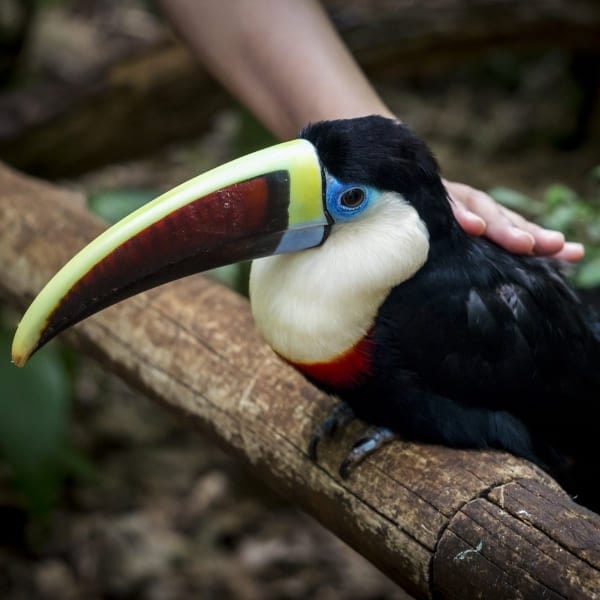
That scarcity is also why the densest concentration of Atlantic Forest birds around Iguazu is not in the forest at all. Parque das Aves, at the gate of the Brazilian park, opened in 1994 on 16 hectares of forest and now shelters more than 1,300 birds from over 130 species, more than 90% of them native to the Atlantic Forest. Over half arrived from trafficking seizures and mistreatment cases, not from a breeding cage.
Beyond rescue, the park actively breeds species for release. Its expansive walk-through aviaries allow birds destined for reintroduction to maintain physical condition and natural behaviors, while initiatives like “Voa, Jacutinga” focus on breeding black-fronted piping guans to restock their native forest habitat.

👉 Read more: 20 Animals in Brazil: Wildlife Facts and Where to Find Them
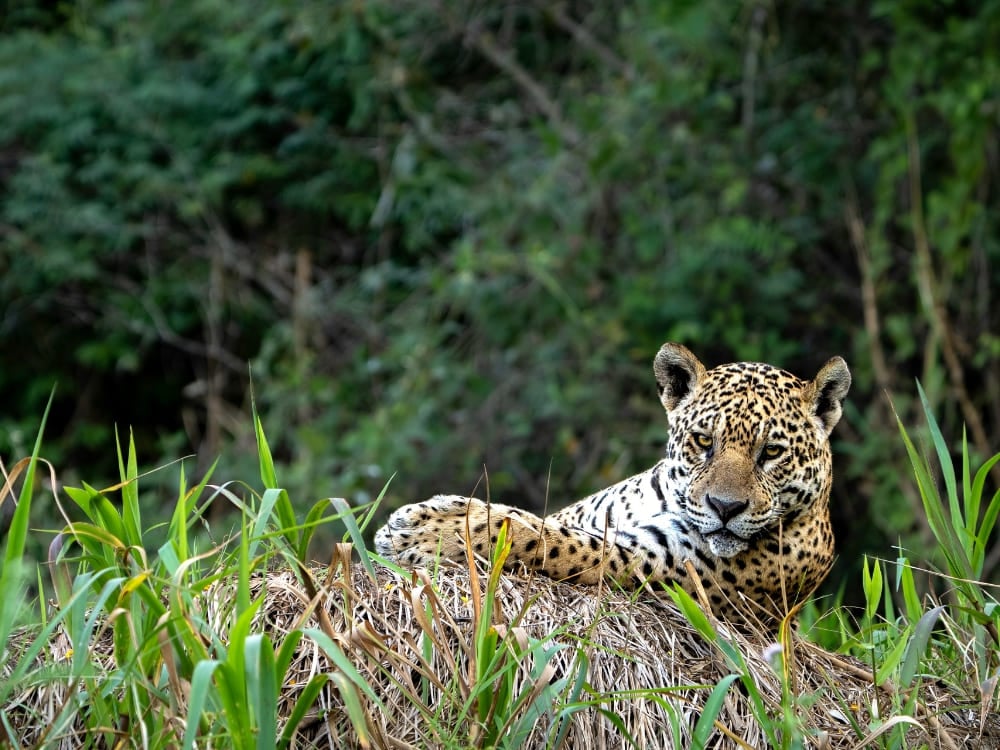
6. Iguazu Falls is one of the last jaguar strongholds in the Atlantic Forest
A fact about Iguazu Falls for wildlife enthusiasts. Since 2005, Brazil’s Projeto Onças do Iguaçu and Argentina’s Proyecto Yaguareté have counted the jaguars of the Green Corridor together, one animal at a time, in a binational census repeated every two years.
The 2022 edition placed 224 camera stations (72 in Brazil and 152 in Argentina) across 582,123 hectares and came back with 3,763 photographs of 55 adult jaguars.
The population those cameras follow has been on a violent ride. Between 1990 and 1995, the region held an estimated 400 to 800 jaguars. By 2005, there were 9 to 11 left. The 2022 census counted about 93 across the corridor and the 2024 census about 84, within a range of 64 to 110.
Those numbers are small, but that’s exactly the point. This is one of the last places in the Atlantic Forest where a jaguar population still functions, in a biome that once ran along most of Brazil’s coast and now survives in fragments.
People visiting Iguazu National Park on the Brazilian or Argentinian sides don’t see jaguars from the walkways, but the cameras set up by scientists whose mission is to protect them always do.
👉 Read more:
- Where is the Best Place to See Jaguars in the Pantanal?
- 10 Fascinating Facts About Jaguars and Why Brazil Is Their Stronghold
7. Iguazu Falls were private property until an aviation pioneer stepped in
In 1916, Santos Dumont came to see the falls and found that they belonged to a private landowner, a Uruguayan named Jesús Val. On May 8, the man who had flown the 14-bis over Paris was received by Afonso Alves de Camargo, governor of the state of Paraná, and argued that the state should expropriate the land and turn it into a park.
Less than three months later, on July 28, 1916, Decree 653 declared 1,008 hectares on the right bank of the Iguaçu River, next to what was then called the Saltos de Santa Maria, to be of public utility. The expropriation itself was only settled in 1919, when Val accepted the compensation.
The parks came later. Argentina created its Iguazú National Park in 1934, and Brazil created Iguaçu National Park on January 10, 1939, through Getúlio Vargas’s Decree-Law 1,035. UNESCO inscribed the Argentine park in 1984 and the Brazilian one in 1986.
Santos Dumont is remembered in Brazil for the airplane. In Foz do Iguaçu, he is remembered as the reason the falls are not behind a private gate.

👉 Read more: National Parks in Brazil Every Nature Lover Should Visit
8. It has been World Heritage in Danger and a New Wonder of Nature
The title is not permanent, and Iguaçu has already come close to losing it. A road called the Estrada do Colono, opened in 1954, cuts the Brazilian park in two. The federal government closed it in 1986, but it was illegally reopened in 1987, and it stayed in use for fourteen more years. In 1999, UNESCO placed Iguaçu National Park on the List of World Heritage in Danger.
The road was finally shut on June 13, 2001, by an operation involving federal military and environmental agencies, which then broke up its surface along its whole length and planted 25,000 seedlings in it. UNESCO removed the park from the danger list in December 2001. The pressure to reopen the road has never stopped.
Ten years later came the opposite kind of headline. In a global public vote that closed at 11:11 on November 11, 2011, Iguazu Falls was named one of the New 7 Wonders of Nature, alongside the Amazon, Ha Long Bay, Jeju Island, Komodo, the Puerto Princesa Underground River, and Table Mountain.
Both things are true, and they are worth holding together. The same stretch of years that made it a wonder of the world is the stretch in which it nearly lost its protection.

9. Exactly one hotel stands inside the Brazilian park
Opened in 1958 in a Portuguese colonial style, the Hotel das Cataratas added wings in 1971 and 1982. Now as Belmond Hotel das Cataratas, it remains the only hotel within Iguaçu National Park.
That address is worth more than the architecture. The park runs on public visiting hours, so everyone else arrives after it opens and leaves before it closes.
Guests staying inside get the trail before the first bus and after the last one, in the two windows when the light is low, the mist catches the sun, and the walkways are empty.


👉 Explore the adventure: 3-Day Luxury Iguazu Falls Tour
10. Five nights a month, Iguaçu National Park opens in the dark
For five nights each month, around the full moon, the Argentine park opens after sunset. There are three departures a night, about two and a half hours each: the Rainforest Ecological Train through the forest under the stars, then the steel walkway out to the Devil’s Throat, lit by nothing but the moon.
What people go hoping to see is a moonbow, a lunar rainbow formed when moonlight refracts through the spray the same way sunlight does by day, only dimmer and almost colorless to the naked eye.
While it is a fascinating phenomenon, a fact about Iguazu Falls’ lunar rainbow is that it is never really guaranteed. It also needs a clear sky, a high moon, and the right amount of mist in the air.

Visiting Iguazu Falls with PlanetaEXO
Now that you know some of the main facts about Iguazu Falls, it’s time to see this natural wonder up close!
PlanetaEXO is an ecotourism platform specializing in Iguazu Falls tours, covering both the Brazilian and the Argentinian sides. Whether that means a budget trip or a luxury experience within the borders of the national park, our team organizes the logistics so all you have to do is enjoy yourself. Contact us now!
Keep reading
October 1, 2026
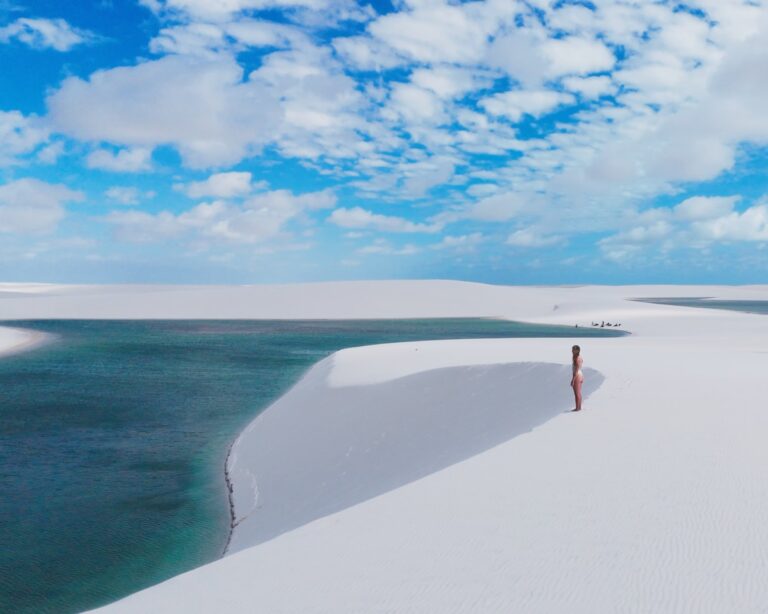
PlanetaEXO’s new mini-doc showcases ecotourism in Lençóis Maranhenses
In “Lençóis Maranhenses: Far From The Crowds, Close To What Matters”, PlanetaEXO’s mini-doc shows how ecotourism is changing life for local communities.
September 30, 2026
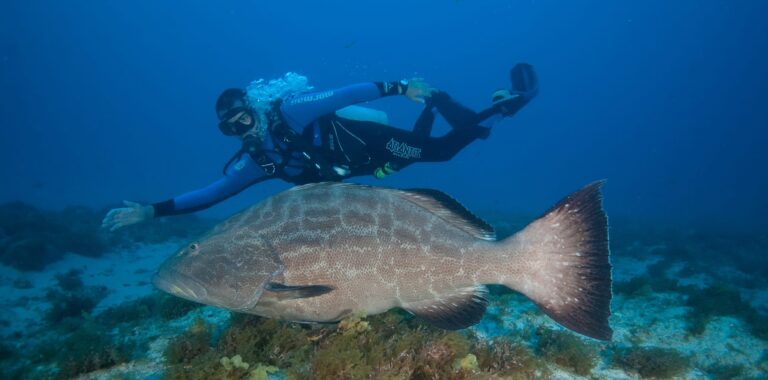
Best Dive Sites in Fernando de Noronha: 21 Spots by Depth and Level
The 21 best dive sites in Fernando de Noronha, with depth, seaside, and level for each, from 8 m beginner reefs to the 62 m Corveta Ipiranga wreck.
September 28, 2026
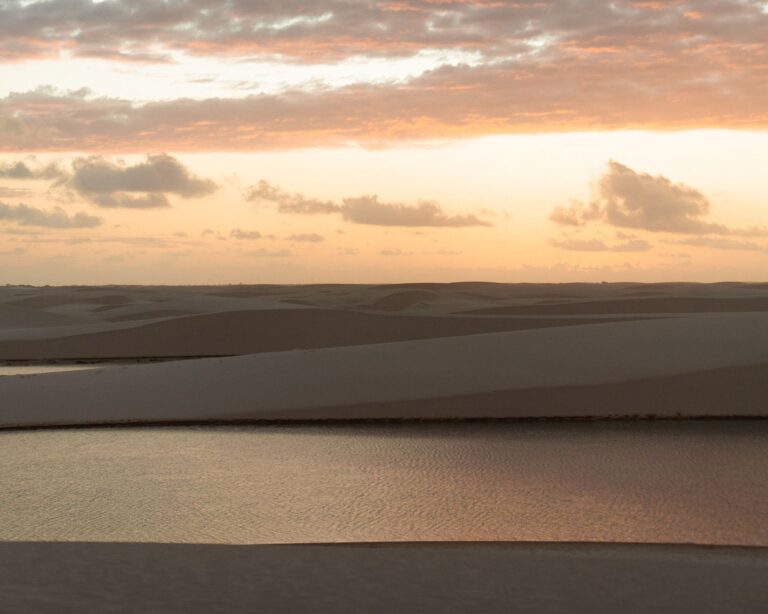
Lovely, Overwhelming, Total Joy: Maja’s 15-Year Wait for Lençóis Maranhenses
15 years of waiting, a 6-day full itinerary, and dunes like snow: a retired Slovenian professor’s honest account of Lençóis Maranhenses.