
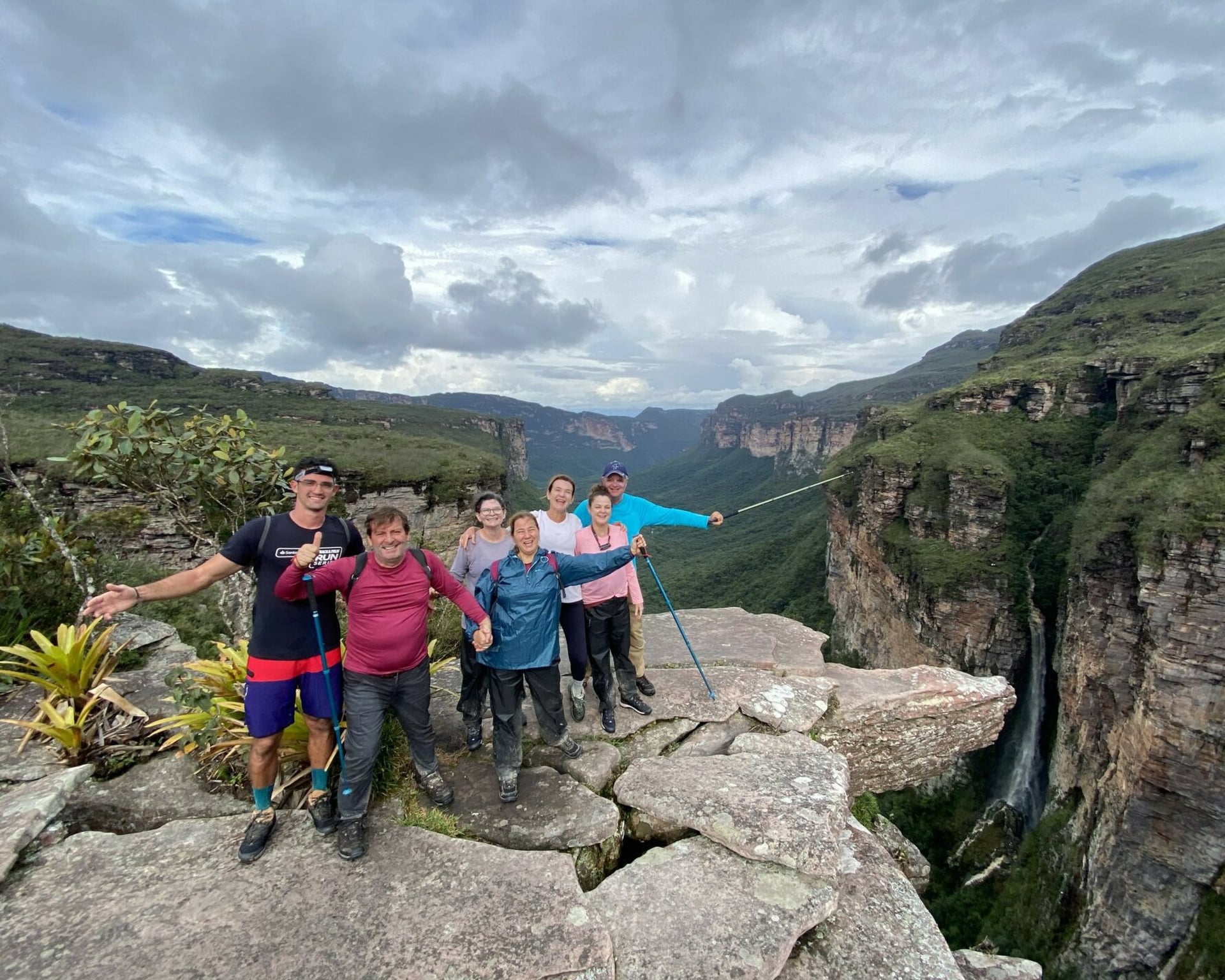
Seven friends and relatives from Paraíba, a group leader aged 59, and a forecast that said stay home. Four days later, they walked out of Chapada Diamantina’s most remote valley with an answer.
The light ran out before the trail did. On the long way down from the Cachoeirão lookout, in a downpour that turned the path into running water, one of the seven hikers had nothing left to see by and walked the last stretch with a hand on the guide’s arm. “Hold on to me,” Gil said. The next day, still in the valley, the hiker described him on camera: “Gil was, with all respect, my crutch. He cared more about me than about himself.”
It was 8 p.m. when they reached the valley home where they were sleeping, nine kilometers of mud behind them, soaked and exhausted and, by every account, elated. Germano, the 59-year-old who had brought them all here, gave the only instruction of the evening: “Open the beer session to celebrate.”

A few days earlier, these seven friends and relatives from Paraíba, in Brazil’s northeast, had almost not come at all. The forecast for Bahia was rain, then more rain, and the group seriously talked about cancelling. What they carried into the valley instead was the question many travelers ask us before they book this trek: is Vale do Pati for all ages?
Back in late December 2021, this was one of the very first groups PlanetaEXO, an ecotourism platform specializing in Vale do Pati trek tours, took into the valley. Almost five years later, we’re revisiting their story. Afterwards, the group told us how it went, in writing and on camera from inside the valley. This is their story.
“This was for sure the greatest adventure of our lives!”
Germano
A valley the coffee left behind
No road reaches Vale do Pati. The valley lies inside Chapada Diamantina National Park, 152,142 hectares of tablelands, canyons and rivers in the interior of Bahia, and covers some 12,300 hectares of it. The usual way in is on foot, from the village of Guiné, up onto a high plateau and then down into the green.
It was not always this quiet. In the 19th century, when coffee grew well in its soil, more than 400 families lived here, with a school, a church and a town hall. When the coffee cycle collapsed around 1930 (worn-out soil, too few hands), people left, and the valley stood nearly empty until the late 1970s. By the time it became part of the national park in 1985, about ten families remained. Families like Mr. Wilson’s, natives of the valley, now cook for trekkers and give them a bed. Their houses are the only places to sleep.
👉 Read more: 10 Facts about Vale do Pati, Brazil

Seven reasons to walk in
“My wife and I said: let’s live an experience with friends!” Germano and his wife, Ana Cláudia, wanted something simple: to do something different with the people closest to them. So they invited family and friends of different ages to share it. But each person who said yes brought a reason of their own.
Jória brought a promise. She had planned this trip with her husband, who died earlier that year. Germano and Ana Cláudia took her in (“I was adopted by them,” she says), and in their very first conversation they invited her to Vale do Pati. Her husband had already bought a shirt for the trek. She wore it for two days on the trail. “He came with me,” she said. “I shouted his name. It gave me strength, it gave me a lot of strength!”
Ana Karla brought a plan she had postponed for years. “I always wanted to live an experience fully integrated with nature, and I kept putting it off, putting it off,” she said. “Then a moment came in my life when I said: now it’s time!” Robertinho came for the place and for the company, “to spend more time with my parents and with dear people, their friends.” Roberto and Adriana completed the group of seven.


Fog on the plateau
In Guiné they met the two men who would walk with them for four days. Saulo and Gil checked everyone’s equipment, went through the briefing, and handed the group to the mountain. The first 300 meters of elevation came in rain and fog, over mud and slippery rock, with walking sticks probing for footing.
Above the climb, the trail runs across the open plateau of the Gerais, about 8 kilometers in all, to the edge where the valley first shows itself: the Mirante do Pati, at around 1,400 meters. By then knees were complaining, and some part of each of them wanted to turn around. Nobody did. “We looked for something different, integrated with nature,” Germano said.


That night they slept at Mr. Wilson’s house, where his family had dinner and beds waiting: no hot shower, no Wi-Fi, and, as it turned out, everything they needed. From that first evening, the guides and the hosts became the group’s safety net. “Our guides made the difference,” Ana Cláudia said. “Technique, patience, tranquility, always attentive and with encouragement!”


Rain on the Cachoeirão trail
The next morning began at 7 a.m. with breakfast made by Nara, Mr. Wilson’s daughter, and her team. Ahead lay the Cachoeirão lookout: about 9 kilometers of trail each way, some five hours of walking to reach the top of the cliffs, taken at the group’s own pace.
Up there, the rain that had almost kept them home paid them back. The cliffs drop about 260 meters from the lookout, and after heavy rain the walls run with far more waterfalls than in the dry months. They swam in the natural pool and ate the picnic the guides had packed, which was better, Germano noted, than the lunch of the group beside them. Ana Karla tried to describe the view and settled for an invitation: “Come to Vale do Pati, you won’t regret it. It’s something you can’t describe, you need to be here and feel it.”


Then the sky opened. Torrential rain caught them on the descent, and the way down became the hardest stretch of the whole trek. Even Jória, the only one who had known the route before, was caught off guard: “I knew well what the Vale do Pati hike was and I had no surprises. I just didn’t expect the rain that increased the trail’s degree of difficulty.” Night came on. One of the group remembers the fear exactly: “When I saw all those challenges on the trail, that torrential rain and the night coming, I got really scared.” And then the arrival: “There’s that feeling: I did it! I won!”

No signal, no calendar
Something shifted after that night. The sun came out, and the group woke, as one of them put it, to “being woken up by birds.” People who had nearly cancelled now walked with confidence. They gave the day to water rather than climbs (the Funis waterfall and its natural pool, then the Lajedo and Bananeiras falls) and treated it as a celebration of everything they had already done.


Their last night in the valley was spent in the Igrejinha area, under a sky crowded with stars, days away from any phone signal. Ana Karla found the words for what that does to a person:

“Here we lose track of time, we don’t know what day of the week it is, we let go of everything. There is no time to fill your heart with anything else because there are so many beautiful things to feed the soul with that there is no space left for the internet.”
Ana Karla
The Rampa
The valley keeps one last test for those leaving it: the Rampa do Pati, the steep trail that climbs back toward Guiné. After everything the rain had thrown at them, they took it together.
At the top, everyone cried. In four days the group had built the kind of bond with Saulo and Gil that usually takes years; by the end, the guides felt like family. “A fraternal hug, in particular, to our guides Saulo and Gil, very efficient and attentive to us,” Roberto wrote afterwards. Germano’s message was shorter: “We would do it all again! Saulo, Gil, and Lucas, our sincere thanks, you have become part of our lives.”

What the valley asks of you
So, is Vale do Pati trekking for all ages? This group’s answer is yes. Germano, at 59, led relatives and friends of different ages through four days of rain and mud, and called it “the greatest adventure of all our lives, for the elders I mean.” But none of them pretended it was easy. “Get ready physically,” one of them advised on camera, “because the challenge is strong.”
Their story also shows what makes the trek possible at any age. The 4-day Vale do Pati trek they walked spreads the valley’s trails over more days than the 3-day version, with more time to rest between them. Groups usually travel with about 1 guide for every 5 trekkers, and the guide sets the pace; every member of this group named Saulo and Gil as the difference, and one of them doubted anyone should try it alone: “I don’t know how a person does a trail like this without a guide.” Mules, which the valley families have always used to carry supplies, can carry your backpack too, at extra cost and booked in advance.
The season matters as much as the legs. From November to April, the months this group walked in, the waterfalls are at their fullest, but the trails are muddier and harder. From May to October the valley is drier and milder underfoot. You do not need trekking experience, only to be comfortable walking several hours a day on rocky, uneven ground, and willing to keep going when your knees complain.

👉 Read more:
- How to visit Vale do Pati, Chapada Diamantina – Travel Guide
- The 5 Best Hikes in Chapada Diamantina: Trails, Waterfalls and Distances
- When is the best time to visit Chapada Diamantina?
- 10 Travel Tips for Chapada Diamantina, Brazil
Trekking Vale do Pati with PlanetaEXO
Germano’s group walked in with a question and walked out with an answer. If the same question is on your mind, the valley is still there, and so are the families who keep it.
PlanetaEXO is an ecotourism platform specializing in hiking and trekking tours in Brazil. We work with experienced local guides and the families who host trekkers inside the valley, and we take care of the transfers to Guiné, the homestays and the meals, so you can focus on the trail. Contact us now!

Keep reading
May 5, 2024
How to visit Vale do Pati, Chapada Diamantina – Travel Guide
Learn everything you need to know to travel to Vale do Pati in Chapada Diamantina, including how to get there, the best time to visit, main activities, and more! Vale…
April 12, 2026
10 Facts about Vale do Pati, Brazil
Looking for an experience in Brazil’s Vale do Pati, the trekking hub of Chapada Diamantina? Learn all about it before booking your trip! Amidst Chapada Diamantina National Park, in the state of Bahia, Vale do Pati is a dream destination for trekkers all over the world. Hiking trails, waterfalls, rock formations, and beautiful landscapes make […]
March 6, 2026
How one Brazilian Woman Conquered her Fears and Found Herself Into the Deep Jungle
For Women’s Month, meet Mariana Sampaio, a young solo traveler who explored Vale do Pati and the Amazon Rainforest